


Table of Contents
- What Makes Premium Pool Accessory Retailers Stand Out
- Best Premium Pool Accessory Brands Across the EU
- Quality Assessment: How Retailers Compare on Durability
- Durable Inflatable Pool Toys for Families: What Sets Them Apart
- EU Pool Accessory Shipping Regulations and Import Duty Protection
- Warranty and After-Sales Support: A Critical Differentiator
- Sustainability and Material Sourcing in Premium Retailers
- Conclusion
- Frequently Asked Questions
Last Updated: September 23, 2026
What Makes Premium Pool Accessory Retailers Stand Out
Premium pool accessory retailers distinguish themselves through durability standards, supply chain transparency, honest warranty coverage, and rigorous quality assurance practices that build trust beyond the initial sale.
The best retailers test durability claims, track customer feedback, and provide real after-sales support. This matters because inflatable pool toys are often purchased for specific occasions, family gatherings, vacation rentals, and birthday parties, where failure means no second chance.
RippleWave exemplifies this approach by positioning itself as an authorized retailer committed to transparency. The company ensures fast delivery with tracking, eliminates import duty surprises, and uses fully recyclable and biodegradable signature shipping boxes, details that signal a retailer thinking about the entire customer experience, not just the transaction.
Best Premium Pool Accessory Brands Across the EU
Premium EU retailers distinguish themselves through third-party safety certification, published material specifications, documented supply chain transparency, and detailed warranty policies that specify failure modes.
The most reliable signal of quality is operational transparency. Retailers that publish detailed specifications, PVC grade, vinyl thickness, UV resistance ratings, and weight capacity signal confidence in their sourcing and accountability.
Supply chain localization offers concrete advantages: faster delivery (3-5 days versus 7-14 for imports) and elimination of import duties. For families planning events or vacation rental operators, delivery certainty is worth a premium.
Look for CE marking and certifications like ISO 9001 (quality management) or ISO 14001 (environmental management), which signal genuine commitment.
The best retailers publish warranty documents specifying what's covered (seam failure, material degradation, valve failure) and excluded (normal wear, improper storage, sharp object damage), showing they've analyzed failure modes.
Premium retailers like RippleWave combine authorized retailer status, fast tracked delivery, and fully recyclable and biodegradable signature shipping boxes. When comparing retailers, ask: Can they publish material specifications? Can they guarantee delivery timeframe? Can they show a detailed warranty document? Yes to all three signals premium operation.
Quality Assessment: How Retailers Compare on Durability
Durability is measurable but rarely published. This framework identifies metrics that separate premium retailers from commodity sellers.
Material Specifications: The Foundation of Durability
For inflatable toys, key specifications are:
- PVC/vinyl grade: Premium retailers source PVC that meets DIN EN 71-1 (safety of toys) or equivalent standards. This means the material has been tested for toxicity, tear resistance, and UV stability. Ask a retailer: "What PVC grade do your suppliers use?" If they can't answer, they don't know their supply chain.
- Material thickness: Measured in millimeters (mm), this directly correlates with durability. A 0.3mm vinyl toy will tear more easily than a 0.5mm toy. Premium retailers publish this specification; commodity retailers don't.
- Seam construction: The seams are where inflatables fail first. Look for retailers that specify whether seams are welded (stronger, more durable) or glued (cheaper, more prone to failure). Some premium manufacturers use double-stitched or triple-reinforced seams for high-stress areas.
- UV stabilizers: Pool toys exposed to sunlight degrade over time. Retailers sourcing from manufacturers that add UV stabilizers to the material will have products that maintain color and structural integrity for 3-5 seasons. Those without stabilizers fade and become brittle after 1-2 seasons.
A lounger with 0.5mm welded seams and UV stabilizers outlasts a lounger with 0.25mm glued seams by 3-4x. Premium retailers publish both specs; commodity retailers publish neither.
Testing Standards: Third-Party Verification vs. Manufacturer Claims
Retailers validate durability claims in three tiers:
- No independent testing: The retailer accepts whatever the manufacturer claims. This is the baseline; it's cheap but offers no protection against false claims.
- Manufacturer testing only: The retailer has seen the manufacturer's internal test reports, but these are not independently verified. Manufacturers have an incentive to pass their own tests.
-
Third-party durability testing: The retailer (or the manufacturer on the retailer's behalf) submits products to independent labs for testing. Common tests include:
- Seam strength testing (how much force before a seam fails)
- Material tear resistance (a standard test for elastomers)
- UV exposure testing (accelerated aging under controlled light)
- Puncture resistance (how sharp an object needs to be to penetrate the material)
A retailer citing verifiable testing standards provides a concrete claim; one saying "Built to last" provides marketing language.
Warranty Specificity: What It Reveals About Failure Modes
A retailer's warranty is a window into what they expect to fail. Compare these three warranty statements:
- Generic: "1-year warranty on manufacturing defects."
- Specific: "1-year warranty covering seam failure, material degradation, and valve defects. Excludes normal wear, improper storage (temperature below -10°C or above 50°C), and damage from sharp objects."
- Detailed: "2-year warranty covering seam failure (including stress-point reinforcement), material degradation (UV exposure, chemical exposure), and valve defects. Covers up to 50% of product cost for partial failure; 100% replacement for total failure. Excludes damage from sharp objects, improper inflation (over 90% capacity), and storage in direct sunlight for more than 6 months continuously."
The detailed example shows the retailer has analyzed failure modes and priced accordingly, avoiding impossible promises while being transparent about edge cases.
Supply Chain Transparency: Warehouse Location and Inventory Turnover
Product storage before delivery affects durability. Premium retailers manage this by:
- Maintaining climate-controlled storage (temperature 15-25°C, humidity 40-60%)
- Rotating inventory regularly (FIFO: first-in, first-out) so customers don't receive products that have been sitting in stock for months
- Storing in opaque, UV-blocking containers
Retailers with multiple EU warehouses can also reduce transit time, which reduces the risk of damage during shipping. A product that arrives within 3 days is less likely to be damaged than one that takes 10 days.
Practical Comparison Framework
When evaluating two retailers on durability, use this checklist:
| Criterion | Commodity Retailer | Premium Retailer |
|---|---|---|
| Material specs published | No | Yes (grade, thickness, UV stabilizers) |
| Seam construction specified | No | Yes (welded vs. glued, reinforcement) |
| Third-party testing | No | Yes (references to DIN, or ISO standards) |
| Warranty length | 30-90 days | 1-2 years |
| Warranty specificity | Vague ("manufacturing defects") | Detailed (lists failure modes and exclusions) |
| Supply chain transparency | Unknown | Published (warehouse locations, inventory turnover) |
| Response to warranty claims | 2+ weeks | 48 hours |
RippleWave's authorized retailer status means manufacturer vetting on material sourcing and testing. Fast tracked delivery reduces transit damage, ensuring products start their lifespan in full condition.
The key insight is that durability is not a mystery. Retailers that are confident in their supply chain publish the data that proves it. Those that don't are either unfamiliar with their own products or unwilling to be held accountable. Premium retailers choose transparency.
Durable Inflatable Pool Toys for Families: What Sets Them Apart
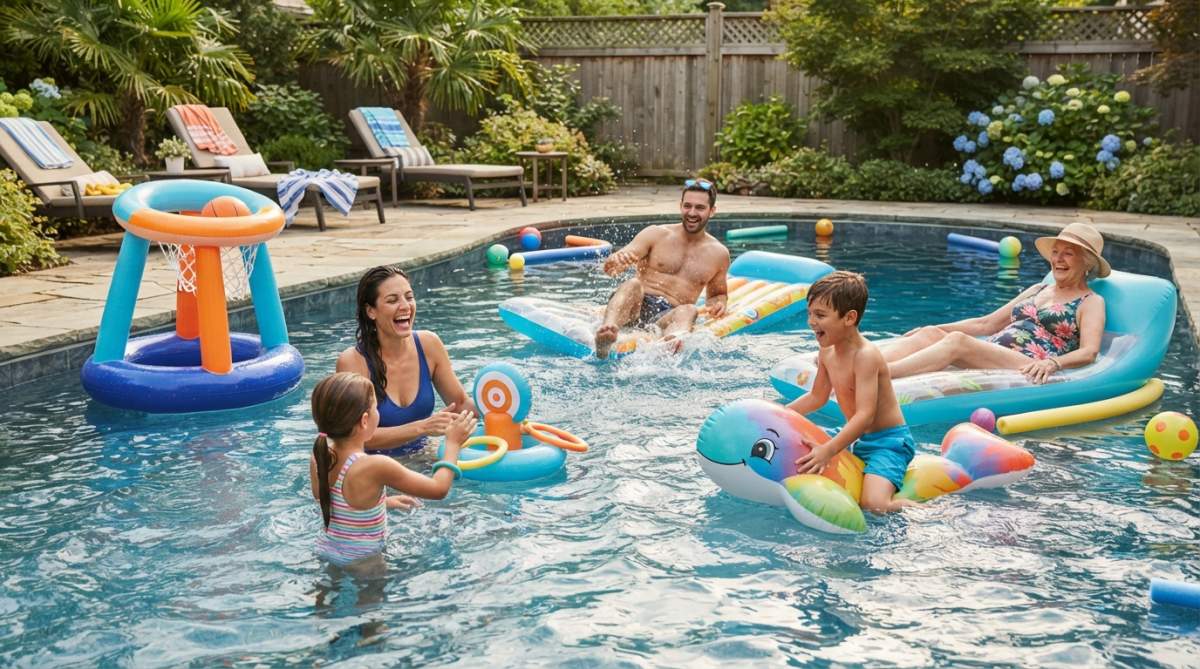
Durable family inflatables balance sturdiness for rough play with safety and ease of handling. Retailers excelling at this understand both requirements equally.
Family-focused inflatables require design intent: a basketball hoop must support teenage dunking while remaining safe for 5-year-olds; a game table must support multiple people while being easy to set up and store.
The best retailers test products with actual families, gathering feedback on sizing, assembly time, and seasonal durability.
EU Pool Accessory Shipping Regulations and Import Duty Protection
Hidden import duties and customs charges are major pain points for EU customers. A €100 purchase becoming €130 at delivery is why retailers eliminating this friction stand out.
Warranty and After-Sales Support: A Critical Differentiator
Warranty coverage reveals retailer confidence: 30-day returns signal expected problems; 1-year defect warranty signals durability confidence; 2-year specific coverage signals analyzed failure modes.
| Support Element | What It Signals | What to Look For |
|---|---|---|
| Warranty length | Confidence in durability | 1+ year minimum |
| Coverage specificity | Understanding of failure modes | Details on what's covered |
| Response time | Customer service priority | Reply within 48 hours |
| Replacement process | Friction in claims | Free shipping for returns |
| Proactive outreach | Genuine customer focus | Follow-up after purchase |
Sustainability and Material Sourcing in Premium Retailers
Environmental responsibility has moved from a marketing advantage to a customer expectation, especially among families making purchasing decisions. Premium retailers are responding by examining material sourcing, manufacturing practices, and end-of-life product handling.
Conclusion
Choosing between premium pool accessory retailers in the EU comes down to three things: durability assurance, transparent shipping practices, and genuine after-sales support. The retailers that excel on all three tend to be the ones families return to year after year.
Frequently Asked Questions
How do I know if a premium pool accessory retailer will actually deliver quality products that last?
Look for retailers offering transparent warranty terms, clear product specifications including material composition and durability ratings, and customer reviews mentioning longevity. Premium pool accessory retailers typically provide detailed technical specifications, multi-year warranties, and after-sales support. Request product certifications and material sourcing information before purchase. Check whether the retailer offers tracking and easy returns if durability doesn't meet expectations.
What should I look for when buying premium pool equipment in the EU to avoid hidden import duties?
Verify the retailer's EU status and whether they handle import duties upfront. Many premium pool accessory retailers operating within the EU absorb import costs or offer duty-free shipping guarantees. Confirm the retailer's warehouse location and whether they ship from within EU borders. Request written confirmation of no additional charges at delivery. Authorized EU retailers typically display compliance certifications and clear shipping policies that address customs handling.
Are durable inflatable pool toys for families worth the premium price compared to budget options?
Premium durable inflatable pool toys typically use higher-grade PVC, reinforced seams, and UV-resistant materials that withstand multiple seasons of use. Budget alternatives often fail within weeks due to material degradation and poor construction. Premium options offer better value over time when measured by durability per season. Additionally, many premium retailers provide replacement parts, repair services, and warranties that budget retailers don't offer, reducing long-term replacement costs.
What's the difference between EU pool accessory shipping regulations and what other regions offer?
EU pool accessory shipping is governed by consumer protection directives and product safety standards that vary slightly by member state. EU retailers must clearly disclose all costs upfront, handle hazardous materials according to IMDG regulations, and provide standardized return rights. Premium retailers operating across the EU often consolidate shipments from centralized warehouses to minimize customs friction. Non-EU retailers may face additional tariffs and longer processing times. EU-based retailers typically offer faster delivery and more transparent regulatory compliance.


