


Table of Contents
- Your 2026 Pool Party Planning Timeline
- Pool Party Safety Checklist for Families and Large Groups
- Pool Party Games for Adults and Kids: What Actually Gets Played
- Pool Party Food Ideas for Large Groups (No Sad Soggy Plates)
- How Many Hours Should a Pool Party Be? Setting the Right Event Timeline
- Budget-Friendly and Eco-Friendly Hosting That Still Feels Premium
- Post-Party Cleanup and Pool Recovery
- Frequently Asked Questions
Last Updated: September 22, 2026
Your 2026 Pool Party Planning Timeline
The difference between a relaxed pool party and a chaotic one is decided before the first guest arrives. Four weeks out, confirm numbers and order supplies to cover delivery lead times. One week out, handle everything weather-dependent.
| Timeframe | Tasks | Why It Matters |
|---|---|---|
| Four weeks out | Guest list, invitations, order games and supplies | Delivery lead time and headcount accuracy |
| One week out | Menu, ice, shade check, weather forecast | Weather-dependent setup decisions |
| Day before | Water chemistry, cleaning, chill drinks | Pool readiness and guest comfort |
| Day of | Setup, rules briefing, supervision plan | Safety and smooth hosting |
Four Weeks Out: Guest List and Invitations
Send invitations four weeks ahead so you have accurate RSVP numbers before buying anything, a headcount that shifts by ten changes food, seating, and shade.
One Week Out: Menu, Supplies, and Weather Check
Finalize the menu one week out, buy non-perishables immediately and perishables two days before. Check the forecast daily from five days out, since a cooler day changes drink quantities and shade needs.
Pool Party Safety Checklist for Families and Large Groups
A pool party safety checklist covers water conditions, supervision ratios, and emergency procedures. Writing it down beforehand means you are not making safety decisions in the middle of a crowd.
Water Chemistry and Pool Maintenance Before Guests Arrive
Test and balance your water 24 hours before the party, not the morning of, chlorine, pH, and filtration need time to settle. Run the filter longer than usual the day before, skim the surface, and brush the walls. If you shock treat, do it a full day ahead. Experienced hosts test twice: 24 hours out to correct, and the morning of to confirm nothing drifted overnight.
Supervision, Pool Rules, and Emergency Preparedness
Set a supervision rotation with named adults and 20-minute shifts, posted where everyone can see it, and brief every adult on where the pool rules and emergency equipment are. For mixed-age groups, use one designated watcher per five non-swimmers or weak swimmers, and never fewer than two adults actively watching when children are in the water, attention fades fast.
- Who calls for help, name one person, not "whoever is closest."
- Where the emergency number is, 112 is the general emergency number, and it works from any phone, including locked mobiles.
- How to reach the water, a reaching pole or throw rope first; only enter the water yourself if you are a confident rescuer and someone else is watching the other swimmers.
- Where to meet, a fixed assembly point on dry land so you can account for everyone quickly.
Making the Party Work for Guests With Mobility or Sensory Needs
Most pool party guides skip this, and it is one of the easiest gaps to close. Ask about access needs in the invitation alongside the RSVP, so you can plan rather than improvise.
A Printable-Style Safety Checklist
- Water tested and balanced 24 hours ahead, confirmed on the morning of
- Filter run longer than usual; surface skimmed; walls brushed
- Chemicals stored locked and labelled, away from the deck
- Fence or gate latch checked and closing fully
- Supervision rotation written and posted, 20-minute shifts
- Watcher ratio set: one per five weak or non-swimmers, minimum two adults
- Rules posted at the deck entrance; glass banned near the water
- Charged phone, first aid kit, and reaching pole within arm's reach
- Emergency plan briefed to every adult, including 112 and the assembly point
- At least two adults CPR-aware; nearest defibrillator location known
- Access needs confirmed with guests; quiet zone and clear path in place
Pool Party Games for Adults and Kids: What Actually Gets Played
The games that get played need no explanation and work for mixed ages. Multiplayer setups beat single-player floats, because guests drift toward whatever lets them compete together.
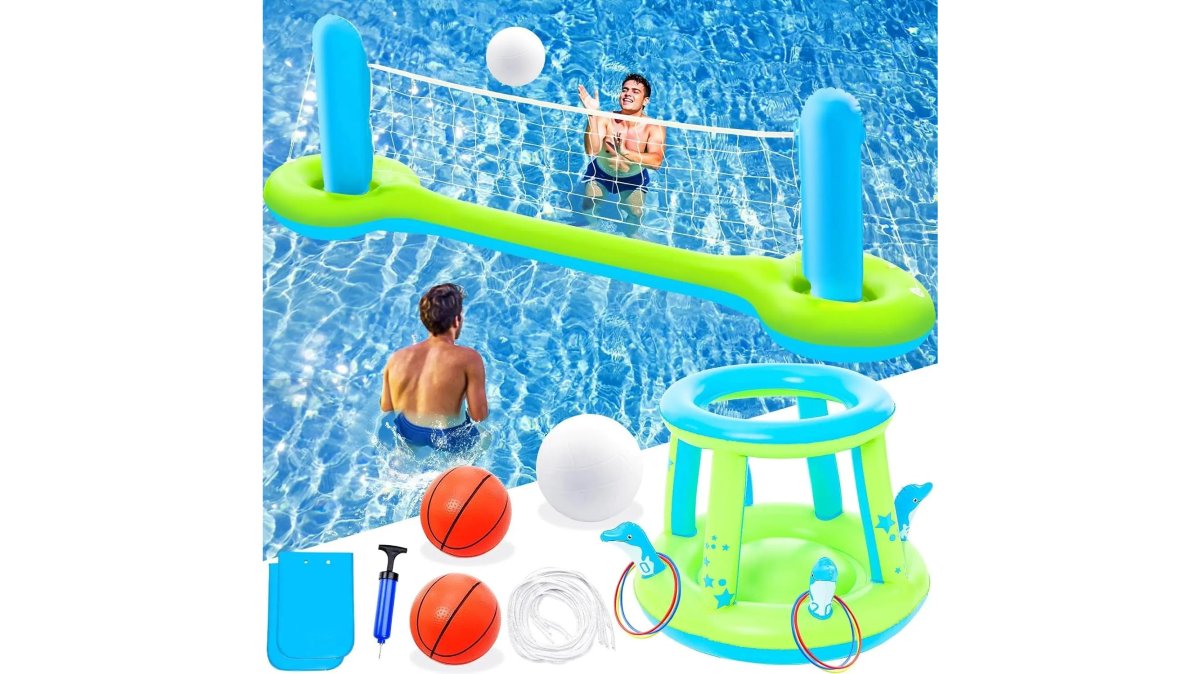
Setting Up a Game Zone on the Pool Deck
Designate one stretch of deck as the game zone, clear of seating, food, and towels. Wet feet on a cluttered deck is how people slip.

Pool Party Food Ideas for Large Groups (No Sad Soggy Plates)
Pool party food ideas for large groups should be hand-held, served away from the water, and easy to eat standing up. Anything needing a knife and fork gets abandoned on a lounger within twenty minutes.
The Menu That Survives Water, Wind, and Wet Hands
Build the menu around finger foods, fruit, and cold refreshments. Set up a hydration station with water and ice far from the pool edge, plus a towel station so wet hands do not reach into shared snack bowls.
| Food Category | Examples | Serving Note |
|---|---|---|
| Finger foods | Skewers, wraps, flatbreads | Served on the deck, not poolside |
| Fruit | Melon, berries, grapes | Chilled in bowls with lids |
| Refreshments | Water, juice, iced tea | Hydration station away from water |
| Grilling | Sausages, vegetable skewers | Cook before guests swim |
How Much Food to Buy Per Guest
Most hosts overbuy snacks and underbuy drinks. For a three-to-four-hour party:
Pool Toys Games Set - 3 in 1 Pool →
- Drinks: plan on roughly one litre of water per guest across the event, plus soft drinks. In warm weather, people drink more than they expect.
- Finger food: six to eight small pieces per guest if it is the main food, three to four if it is a snack alongside a grill.
- Fruit: around 150-200 g per guest is generous without leaving bowls half-full.
- Ice: budget about 0.5 kg per guest. Ice is the item most often forgotten and the hardest to improvise.
Budget-Friendly Hosting Without the Cheap Look
Hosting well does not require a big spend. The costs that balloon are disposable plates, single-use decorations, and last-minute replacements for cheap equipment that breaks. Buy reusable where it lasts and durable where it matters: a well-made inflatable game set costs more upfront but survives multiple summers, and reusable plates, cups, and cutlery pay for themselves after two or three gatherings.
Three swaps that cut cost without cutting atmosphere:
- Reusable tableware instead of disposables, cheaper per use and no bin bag of waste.
- A shared grill instead of catered platters, sausages and vegetable skewers feed a crowd for a fraction of the price.
- Tap water in a large dispenser with fruit and ice instead of bottled drinks, in Finland, tap water is safe to drink and among the most closely monitored in Europe, so a jug of iced tap water with lemon and mint is both free and genuinely good.
Reducing Waste Without Making It a Chore
The waste a pool party generates is mostly avoidable, and the fixes are simple.
- Label a bin system. Two clearly marked bins, one for recyclable packaging and one for mixed waste, cut contamination and make the end-of-night clear-up faster. Mirror the categories guests use at home.
- Skip single-use decorations where they will end up in the water. Reusable bunting, fabric banners, and solar or rechargeable string lights survive the season and pack away.
- Serve from dispensers, not individual packets. A water dispenser, a jug of iced tea, and bowls of fruit replace a shelf of single-serve cartons and wrappers.
- Rinse and dry inflatables properly so they last multiple summers rather than one, the most sustainable pool toy is the one you do not have to replace.
How Many Hours Should a Pool Party Be? Setting the Right Event Timeline
A pool party should run three to four hours for families with young children and four to five hours for adult groups. Beyond four hours, attention drops, supervision gets sloppy, and children get overtired. Structure the timeline in phases: arrival and rules briefing, active swimming and games, food break, then a shorter second swim, with a wind-down window so guests leave before exhaustion sets in.
Budget-Friendly and Eco-Friendly Hosting That Still Feels Premium
RippleWave ships in fully recyclable and biodegradable signature boxes, so hosting with less waste does not mean compromising on the setup. For a party that feels considered rather than expensive, focus on lighting, a good playlist through waterproof speakers, and comfortable outdoor seating.
Post-Party Cleanup and Pool Recovery
Cleanup starts the same evening, not the next morning. Leftover food, wet towels, and pool debris get harder to deal with after a night of sitting.
- Clear all food and drinks from the pool deck and store or dispose of them
- Collect wet towels into one bin and hang them to dry
- Skim the pool surface and check the filter basket for debris
- Deflate and dry inflatables fully before storing to prevent mould
- Run the filter overnight and retest water chemistry the next day
- Check chlorine levels and rebalance if guest numbers were high
Frequently Asked Questions
How many hours should a pool party be?
For a family-friendly pool party, plan for three to four hours. This gives guests time to swim, eat, and play games without overtiring younger children. If you are hosting adults only, four to five hours works well. Always schedule a break from the water every 60 to 90 minutes so people can reapply sun protection and hydrate. A clear start and end time also helps with cleanup and pool recovery.
What safety precautions are required for private pool gatherings?
A pool party safety checklist should include constant adult supervision, especially when young children are present. Designate a responsible adult as a watcher who is not distracted by hosting duties. Keep a phone charged and nearby for emergencies. Check water chemistry and shock treatment the day before. Remove toys from the pool when not in use so they do not block visibility. Set and explain pool rules at the start, such as no diving in shallow areas and no running on the pool deck.
How do I manage catering for a large group at a pool party?
For large groups, choose finger foods and refreshments that do not require cutlery. Set up a hydration station away from the pool edge with water, ice, and cups. Use a towel station and clearly separate food from the pool deck to avoid wet hands near shared dishes. If you are grilling, cook in batches and keep hot food in insulated containers. For pool party food ideas for large groups, stick to items that hold up in heat, like wraps, fruit skewers, and chilled salads.
How can I create a pool party invitation that gets RSVPs?
Send invitations two to three weeks ahead with a clear RSVP deadline. Include the date, start and end time, address, what to bring (towel, sun protection, change of clothes), and whether food is provided. For pool party games for adults, mention if there will be a tournament or theme so guests come ready to join. Use a simple digital invite or a group message with a poll for dietary needs. A firm RSVP date helps you plan food quantities and seating.
How do I host a pool party if I don't have a pool?
You can still host a water-themed party using a rented community pool, a vacation rental with a pool, or a backyard setup with sprinklers, water tables, and inflatable pools. Focus on the same planning steps: guest list, safety supervision, food, and games. For pool party games for adults without a pool, set up dry-land versions like cornhole or ring toss on the lawn. Just confirm rules and capacity limits with the venue before booking.
What pool party games work for both kids and adults?
Multiplayer games that do not require advanced skill work best. A 3-in-1 pool games set with volleyball, basketball, and ring toss lets kids and adults play together because the rules are simple and the equipment is durable. Floating cornhole sets also bridge age gaps since bean bags are lightweight and the target is large. For a calmer option, a floating game table works for card or tile games in the water. Rotate games every 30 minutes to keep energy up.


