


Table of Contents
- Why Eco-Friendly Water Games Matter for Families
- Quick Comparison: Sustainable Water Toys for Your Backyard
- 1. Reusable Water Balloons and Splash Games
- 2. Pool Games with Floating Toys and Ring Toss
- 3. Water Games Without a Pool: DIY Sprinkler Challenges
- 4. Low-Water Outdoor Games for Families
- How Long Do Biodegradable Pool Toys Last and Why It Matters
- Storage, Care, and Extending the Life of Your Water Toys
- Frequently Asked Questions
Last Updated: October 8, 2026
Why Eco-Friendly Water Games Matter for Families
Choosing sustainable water activities for your family isn't just about reducing waste, it's about building lasting memories without compromising the planet your kids will inherit. At RippleWave, we help families transform their summer routines by offering reusable, durable alternatives that hold up through entire seasons of play.
The shift toward eco-friendly water games reflects a broader change in how families approach outdoor entertainment. Rather than replacing deflated balloons and broken inflatables every few weeks, parents are discovering that investing in quality, reusable water toys delivers both better value and genuine environmental benefits. These games keep children active, engaged, and offline while reducing the plastic waste that typically accumulates after a single summer.
What makes eco-friendly water games particularly appealing is that they don't require sacrifice. Your family doesn't lose out on fun, competition, or variety. Instead, you gain durability, cost savings over time, and the peace of mind that comes from choosing products designed to last. Below, we'll show you exactly how to set up sustainable water play that works for every age and backyard setup.
Quick Comparison: Sustainable Water Toys for Your Backyard
| Product Type | Best For | Durability | Setup Time | Cost Range |
|---|---|---|---|---|
| Reusable water balloons | Splash games and water fights | 100+ uses per balloon | 2-3 minutes | €20-€35 |
| Floating pool games | Ring toss, basketball, cornhole | 2-3 seasons with care | 5-10 minutes | €18-€50 |
| Diving rings and toys | Skill-building and treasure hunts | 3+ seasons | 5 minutes | €35-€50 |
| DIY sprinkler setups | Low-water backyard play | 1-2 seasons | 10 minutes | €5-€20 |
| Inflatable game boards | Tic-tac-toe, dart games | 2-3 seasons | 10 minutes | €27-€48 |
1. Reusable Water Balloons and Splash Games
Reusable water balloons solve the biggest problem with traditional single-use balloons: waste. Instead of buying hundreds of latex balloons that burst after one use, reusable versions can handle 100+ refills, making them the most practical choice for families who play water games regularly.
The key difference is construction. Quality reusable water balloons feature self-sealing nozzles that close automatically when you pull them out of the water, eliminating the need to tie knots. This speeds up setup and makes them accessible even for younger children. They're typically made from silicone or flexible rubber designed to withstand repeated filling and impact without degrading.
How to set up a reusable water balloon game:
- Fill balloons using a hose or bucket system (most self-sealing designs fill in seconds)
- Arrange players in two teams facing each other, 3-4 meters apart
- Establish a "splash zone" where players can move freely
- Players toss balloons underhand to opponents; direct hits count as points
- First team to land 10 hits wins
The environmental benefit is substantial. Switching to reusables can help eliminate waste while offering long-term value. For families seeking premium options, RippleWave carries reusable alternatives that maintain their sealing performance through hundreds of uses.
2. Pool Games with Floating Toys and Ring Toss
Pool games with floating toys and ring toss challenges transform a standard swimming pool into a competitive arena. These games work for families with pools of any size and keep players engaged across multiple skill levels simultaneously.
Ring toss games float on the water's surface, requiring players to toss rings from the pool edge or while swimming. The challenge increases with distance and water movement.
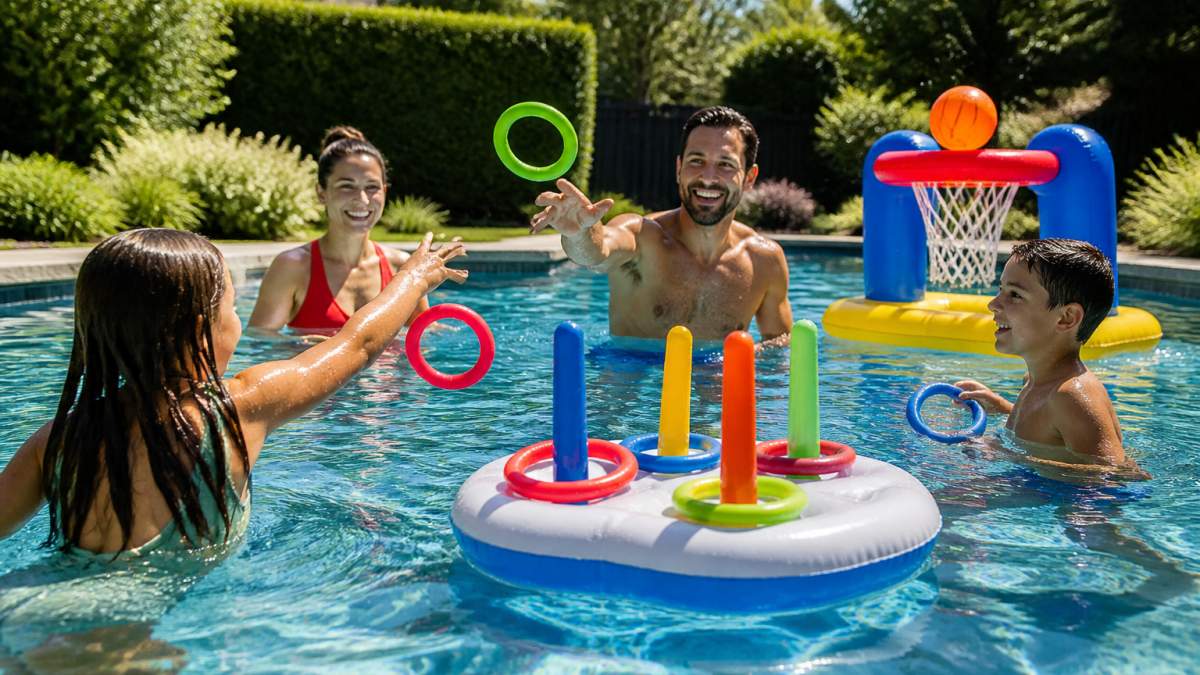
Quality floating pool games are constructed from durable PVC materials that resist chlorine degradation and UV exposure. RippleWave's floating pool basketball and ring toss set (€36.99) includes an inflatable hoop base, two basketballs, and six tossing rings.
Setting up a floating ring toss game:
- Inflate the floating target fully and position it in the pool center
- Establish throwing positions: 2 meters for younger children, 3-4 meters for older players
- Each player gets three tosses per round
- Rings that land on the target post score points (typically 1-3 points depending on difficulty)
- Play continues until someone reaches a target score (typically 21 points)
The durability advantage here is critical. Quality floating games remain watertight through entire seasons when properly maintained. Most hold their inflation for days without requiring re-pumping.
3. Water Games Without a Pool: DIY Sprinkler Challenges
Not every family has a pool, but water games without a pool remain entirely accessible through DIY sprinkler setups and low-water alternatives. These games consume significantly less water than pool-based activities while delivering equivalent entertainment value.
A basic DIY sprinkler challenge requires only a hose, sprinkler head, and open lawn space. The simplest setup involves positioning a sprinkler in the center of a marked zone and having players navigate through the spray without getting wet, or, for younger children, trying to get as wet as possible while staying within a defined boundary.
More elaborate DIY water games include obstacle courses where players navigate between sprinkler zones, relay races where teams carry water-filled buckets across finish lines, or "water wall" challenges using plastic sheeting and duct tape to create barriers that players must break through with water pressure.
Building a DIY water obstacle course:
- Arrange sprinkler heads in a line, spacing them 2-3 meters apart
- Set each sprinkler to spray height (typically 1-1.5 meters)
- Mark a start line and finish line
- Players race through the sprinkler zone, attempting to avoid direct spray
- Fastest time without stopping wins
These setups can consume less water than filling a pool for the day, making them genuinely low-water outdoor games for families concerned about sustainability. The setup takes 10 minutes and requires no special equipment beyond standard garden tools.
4. Low-Water Outdoor Games for Families
Low-water outdoor games for families extend beyond sprinklers to include sponge-based water games, water piñatas, and modified relay races that minimize consumption while maximizing engagement.
Sponge ball games use water-saturated sponges instead of balloons or streams. Players soak sponges, toss them at targets, and score points based on accuracy. A single bucket of water can support continuous play, compared to the larger volume required for a typical pool session.
Beach Balls - 20 Inch Beach Balls, Rainbow Color Pool Ball Inflatable Ball →
Water piñatas, inflatable targets filled with water that burst when struck with a stick or bat, offer another low-water alternative. These games require only the initial filling and provide entertainment for groups of 8-12 players simultaneously. Once the piñata breaks, the game ends, making it ideal for special occasions rather than regular play.
Relay races modified for water play include:
- Bucket brigade: Teams pass water-filled buckets down a line, attempting to fill a target container without spilling
- Sponge squeeze: Players soak sponges, run to a bucket, and squeeze water out; team with the most water at the end wins
- Water balloon toss relay: Partners toss reusable water balloons while stepping backward; last team with an intact balloon wins
These games use less water compared to pool-based alternatives. For families prioritizing sustainability without sacrificing variety, low-water games offer genuine environmental benefit alongside entertainment.
How Long Do Biodegradable Pool Toys Last and Why It Matters
Biodegradable pool toys represent an emerging category designed to break down naturally when disposed of, addressing the long-term environmental concern of plastic accumulation. Understanding their lifespan helps families make informed choices between traditional, reusable, and biodegradable options.
Most biodegradable pool toys are constructed from plant-based materials like corn starch or algae-derived plastics. Under normal use conditions, these materials typically remain intact for 1-2 seasons before showing signs of degradation.
The practical lifespan depends on storage and maintenance. Toys kept indoors and used seasonally last longer than those left poolside year-round. Chlorine exposure degrades many biodegradable materials faster than freshwater, so toys used in saltwater pools may degrade more slowly than expected.
Why this matters: Traditional plastic pool toys persist in landfills indefinitely. Biodegradable alternatives reduce long-term environmental impact, though they don't eliminate the resource consumption required to manufacture them initially.
RippleWave carries durable, long-lasting pool toys designed for repeated seasonal use rather than single-season disposal. The durability approach, investing in toys that last 2-3 seasons, delivers environmental benefit.
Storage, Care, and Extending the Life of Your Water Toys
Proper storage and maintenance determine whether your eco-friendly water games deliver value for multiple seasons or require replacement after a single summer. The difference between toys that last one season and toys that last three seasons often comes down to post-play care.
Storage fundamentals:
- Drain all water completely before storing inflatable toys
- Allow toys to dry fully in shade before folding (wet storage promotes mold and material degradation)
- Store in a cool, dry location away from direct sunlight
- Use breathable storage containers or bags that allow air circulation
- Keep toys away from sharp objects, rodents, and extreme temperature fluctuations
Maintenance practices:
- Inspect toys monthly for small leaks or damage (small punctures can be patched with repair kits)
- Clean toys with mild soap and fresh water after pool use to remove chlorine residue
- Check valve seals and tightness before each use
- Avoid storing toys in compressed bundles; lay them flat or roll loosely
- For reusable water balloons, rinse nozzles thoroughly after use to prevent mineral buildup
Most quality inflatable pool toys from RippleWave include repair patches and instructions for extending lifespan. A small puncture that would permanently disable a cheap inflatable can be patched and used for another season or two with proper materials.
The cost-per-use calculation shifts dramatically when toys last multiple seasons. A €36.99 floating pool game that lasts three seasons costs approximately €12 per season.
Families that prioritize sustainability don't have to sacrifice fun or variety. By choosing reusable water games, investing in durable inflatable toys, and maintaining them properly, you reduce waste while creating summer traditions that last. RippleWave offers a full selection of durable, family-friendly water games designed to withstand multiple seasons of regular use.
Frequently Asked Questions
What are the best reusable alternatives to single-use water balloons?
Reusable water balloons made from soft, durable silicone or fabric are the most sustainable choice. Unlike traditional balloons that create plastic waste, these refillable options can be used hundreds of times across multiple summers. Many families also use sponge balls soaked in water or DIY water bombs made from recycled fabric scraps. These alternatives reduce landfill impact while keeping water play engaging and fun for children of all ages.
How can families play water games while using less water?
Low-water outdoor games for families include sponge-based games, sprinkler relay races, and water-toss challenges that require only a bucket or hose. Obstacle courses with minimal water stations, sponge-ball throws, and timed splashing games conserve water while maintaining excitement. Games like ring toss and cornhole can be played wet or dry depending on your preference. Combining low-water games with reusable toys ensures your summer fun doesn't strain local water resources.
What water games can you play without a pool?
Water games without a pool include sprinkler tag, sponge relay races, water balloon toss (using reusable balloons), and DIY water stations with buckets and hoses. Obstacle courses with water stations, sponge-based games, and backyard water walls made from recycled materials are excellent alternatives. These games work on lawns, driveways, or beaches and require minimal setup. They're perfect for families without pool access and often use less water than traditional pool games.
How long do biodegradable pool toys last compared to standard plastic toys?
Biodegradable pool toys typically last 2-3 seasons with proper care. Many durable eco-friendly options made from reinforced, thickened PVC are designed to withstand multiple seasons of regular use. The key difference is that biodegradable toys break down naturally at end-of-life. Choosing high-quality, durable water toys, whether biodegradable or standard, and storing them properly extends their lifespan significantly.
Are eco-friendly water games suitable for different age groups?
Yes, eco-friendly water games can be adapted for ages 3 and up. Younger children (3-5) enjoy simple games like sponge-ball toss and shallow water play with supervised toys. Older kids (6-12) thrive with competitive games like ring toss, cornhole, and relay races. Teenagers and adults enjoy strategic games like tic-tac-toe on water and basketball challenges. Most sustainable water toys come with age recommendations, and games can be modified for skill levels, making them inclusive for entire families.


