


Table of Contents
- How to Judge Pool Toy Quality Before You Buy
- Durable Inflatable Pool Toys: What Separates One Summer From Five
- RippleWave Pool Toys: Quality You Can Check Before You Buy
- Inflatable Pool Toy Maintenance Tips That Add Seasons
- How to Repair Inflatable Pool Toys Without Buying New
- Environmental Impact and Cost-Per-Use: The Real Math
- Frequently Asked Questions
Last Updated: September 19, 2026
How to Judge Pool Toy Quality Before You Buy
Pool toy quality comes down to three measurable things: vinyl thickness, seam construction, and valve design. Get them right and an inflatable survives five summers instead of one.
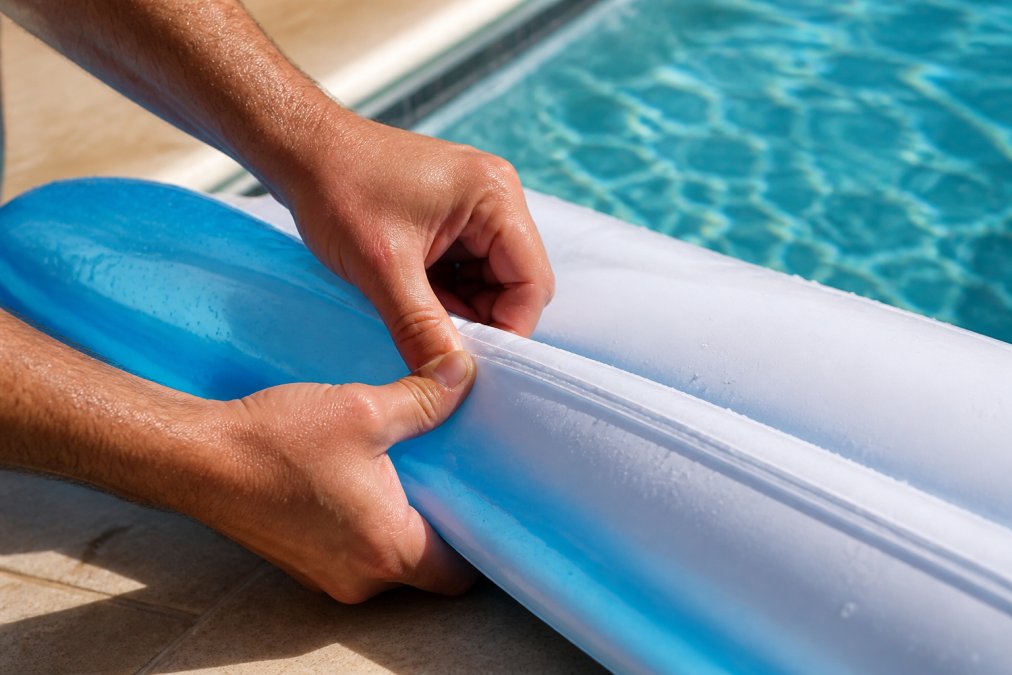
Three specs decide almost everything:
- Vinyl thickness: measured in millimetres. Below 0.20mm is disposable. Around 0.22mm and up is where multi-season toys start.
- Seam type: heat-welded seams outlast glued seams by a wide margin, especially in chlorinated water.
- Valve design: a two-stage valve with an internal flap holds air even if the outer plug works loose.
Material Thickness and Seam Construction
Thickness is the number you can verify. Manufacturers proud of their vinyl print it on the box. If a listing does not state a millimetre figure, treat that as a signal.
Valve Design and Air Retention
A leaking valve is the most common failure we see, and the cheapest to avoid. Two-stage valves have an inner flap that closes when you stop inflating, plus an outer cap; single-stage valves rely on the cap alone.
Durable Inflatable Pool Toys: What Separates One Summer From Five
The gap between a one-summer toy and a five-summer toy is polymer chemistry, UV stabilization, storage habits, and early patching. The real question is not "is the vinyl thick" but what it is made of and what has been added to it.
What Pool Vinyl Actually Is
Almost every inflatable pool toy is made from one of three base materials:
- PVC (polyvinyl chloride): The dominant material. Cheap, weldable, holds air well. Raw PVC is rigid, so manufacturers blend in plasticizers (usually phthalates or non-phthalate alternatives) to make it flexible.
- TPU (thermoplastic polyurethane): More expensive, more abrasion-resistant, and more UV-stable than PVC. Common in higher-end camping gear and premium pool floats. Welds cleanly and resists plasticizer migration.
- Silicone-coated or laminated fabrics: Rare in consumer pool toys because of cost. Excellent UV and chlorine resistance, poor puncture resistance relative to thick PVC.
The Two Degradation Mechanisms That Kill Inflatables
1. UV degradation. UV-A and UV-B light breaks the carbon-chlorine bonds in PVC, shortening the polymer chain so the material cracks at stress points, fold lines, seams, and the valve collar. UV stabilizers (often hindered amine light stabilizers, or HALS) absorb that energy before it does damage. You cannot test for stabilizer content visually, but you can slow degradation: deflate and shade toys when not in use, and never store them inflated on an open deck through a heatwave.
Puncture Resistance and the Base-Layer Question
Punctures are mechanical, from lawn debris, pool-deck edges, and pet claws. Thickness alone is not the answer, a 0.30mm sheet with a poor plasticizer blend cracks at a fold before a well-formulated 0.22mm sheet does. Lay a towel or blanket under inflatables out of the water, since most punctures happen on land.
Why Repairability Is a Quality Feature
Repairability is a quality feature, and it is the one you can verify before buying. A toy with accessible seams, a standard valve size, and a PVC surface that accepts cement stays in service for years.
Before you buy, check three things:
- Is the valve a standard size? Replacement valves are sold in a handful of common diameters.
- Is the surface plain PVC or coated? Coatings that give a glossy or fabric-like finish often resist PVC cement.
- Are the seams accessible? If a leak forms at a seam buried under a decorative panel, your patch has nowhere to sit.
RippleWave Pool Toys: Quality You Can Check Before You Buy
Every product we carry lists its vinyl thickness, weight capacity, and dimensions, so you can run the three-point check above before ordering. You should not have to guess whether a raft is 0.18mm or 0.22mm.
Battle Logs and Jousting Sets
The 4-piece aerated battle log set is the entry point at €38.99. Each log holds up to 100kg and measures roughly 28cm by 130cm. It suits two players, ages 14 and up.

Dinosaur Hammers and Giant Loungers
For younger kids, the dinosaur float set at €89.00 pairs two floats with two hammers. The hammers have rigid plastic handles, which stops the bending you get on cheap inflatable bats. The floats have four feet and two handles, so kids can paddle and stay upright.
8 Pcs Jumbo Inflatable Floating Row →

| Product | Price | Vinyl / Capacity | Best For |
|---|---|---|---|
| 4-piece battle logs | €38.99 | PVC, 100kg per log | Two players, ages 14+ |
| 8-piece jumbo battle logs | €60.99 | 0.22mm PVC, 200lbs per raft | Families, 3-6 players |
| Inflatable canoe set | €50.00 | PVC, 80kg per seat | Pairs, easy storage |
| Dinosaur float set | €89.00 | Non-toxic vinyl, ages 3-12 | Younger kids |
| Giant black swan | €75.99 | Multi-chamber, 2 adults | Adults, lounging |
Inflatable Pool Toy Maintenance Tips That Add Seasons
Rinsing with fresh water after every use is a high-return habit, a two-minute rinse removes the chlorine and salt residue that degrades PVC. A full routine:
- Rinse with fresh water after each use, inside and out
- Dry completely in shade before folding, never in direct sun
- Deflate to about 90%, not fully, for short-term storage
- Store folded in a cool, dry place away from sunlight and heat
- Check the valve seal monthly during the season
- Patch any leak the week you find it, not at season's end
How to Repair Inflatable Pool Toys Without Buying New
Most inflatable failures are repairable with a patch kit. But the generic "clean, cut, glue, press" advice fails more often than it works, because it skips the two things that determine whether a patch holds: surface preparation and patch material matching.
Step 1: Find the Leak Properly
Do not guess. Inflate the toy to about 80% and work methodically.
- Soapy-water test: Spray soapy water along every seam, the valve collar, and any fold line. Bubbles mark the hole, catching most leaks in under five minutes.
- Submersion test: For slow leaks, submerge the inflated toy section by section in a bathtub. A bubble trail rises from the leak point.
- Valve test:
Step 2: Match the Patch to the Material
A patch that does not match the base material peels within a week.
- PVC toys: Use a PVC patch and PVC cement (vinyl adhesive). The cement softens both surfaces so they fuse into one layer, the only method that genuinely welds.
- TPU toys: PVC cement will not bond to TPU. Use a TPU-specific adhesive or a heat-activated patch, and test on a hidden area first if unsure of the material.
- Coated or laminated surfaces: Adhesives often fail here; a heat-activated patch (iron on low heat over a cloth) is usually the only reliable option.
Step 3: Prepare the Surface, The Step Everyone Skips
PVC cement will not bond to a wet, oily, or dusty surface, the single most common reason patches fail.
- Deflate the toy fully so the repair area is flat and slack.
- Clean around the leak with isopropyl alcohol and let it dry completely.
- Roughen the surface lightly with fine sandpaper or a scouring pad.
- Wipe away dust and let the area sit a few minutes.
Step 4: Apply the Patch
- Apply a thin, even coat of PVC cement to both the patch and the toy surface.
- Let both coats tack up for 30 to 60 seconds, sticky but not wet.
- Press the patch firmly into place, working from the center outward to push out air bubbles.
- Hold firm pressure for 60 seconds.
- Weight it down with a book or flat object and leave it 24 hours before inflating, inflating early will lift the patch.
Step 5: Replace the Valve If That Is the Failure
Valve leaks are a common failure on inflatables. Most standard valves unscrew (threaded collar) or pry out with a flathead screwdriver, and replacement kits come in a handful of common diameters.
- Deflate the toy completely.
- Unscrew or gently pry out the old valve.
- Clean the valve seat and let it dry.
- Apply PVC cement to the new valve flange and press it into the seat.
- Weight it down and leave it 24 hours before inflating.
What Is Not Worth Repairing
Some failures are not worth the patch kit:
- Large tears along a seam where the vinyl itself has torn, not just separated, the repair will always be a weak point.
- Multiple leaks in the same area, usually meaning the plasticizer has migrated out and the vinyl is brittle; patching one hole just moves the failure to the next weak spot.
- Brittle, cracking vinyl. Once PVC has lost its plasticizer, no patch restores flexibility.
Environmental Impact and Cost-Per-Use: The Real Math
Cost-per-use turns durability into arithmetic. A €60 inflatable that lasts four seasons costs €15 per season; a €25 inflatable that lasts one costs €25 per season, and you buy four of them. Over five years the cheap option costs more, not less. The premium is a bet on how many summers the product survives.
Frequently Asked Questions
How do I identify high-quality inflatable pool toys?
Look for PVC thickness of at least 0.20mm, welded or double-stitched seams, and a valve with a secondary stopper. Check the weight capacity and whether the listing specifies UV-stabilized or chlorine-resistant material. Toys that list these details in the product description are usually built to last more than one season. RippleWave's battle log sets use 0.22mm PVC and support 200lbs per float.
How does material thickness affect the lifespan of pool toys?
Thicker PVC resists punctures from pool edges, toys, and rough play. Thicker PVC resists punctures from pool edges, toys, and rough play.
What are the best practices for maintaining inflatable pool toys?
Rinse with fresh water after every use to remove chlorine or salt. Dry fully before deflating and storing. Keep toys out of direct sunlight when not in use, and store them in a cool, dry place. Check seams and valves monthly for early signs of wear. A patch kit costs a few euros and can extend a toy's life by a full season or more.
Are premium pool toy brands worth the extra cost?
A €60 float that lasts four summers costs €15 per summer. A €25 float that punctures after one season costs €25 per summer. The cheaper option costs more per year of use. Cost-per-use is the number that matters.
Can I repair a punctured inflatable pool toy?
Yes. Most PVC pool toys come with or can use a patch kit. Clean and dry the area around the puncture, apply PVC cement and a patch, then let it cure for 24 hours before inflating.


