


Table of Contents
- Water Confidence Games for Toddlers
- Interactive Water Games for Beginners
- Pool Safety Rules for Families
- Best Pool Games for Preschoolers (Ages 3-5)
- Best Pool Games for School-Aged Children (Ages 6-12)
- Equipment-Free Pool Games for Young Children
- Sensory-Friendly Pool Games and Post-Pool Transitions
- Frequently Asked Questions
Last Updated: September 17, 2026
Water Confidence Games for Toddlers
The best pool games for young children start long before anyone touches a ball. For toddlers, the goal is comfort, not competition, the families who get the most from their pool spend the first weeks building water confidence.

- Humpty Dumpty sits on the wall. Your child sits on the edge, sings the rhyme, and "falls" gently into your waiting arms. Repeat until the splash becomes the fun part.
- Blow the bubbles. Have your child blow at a floating ping-pong ball to move it across the surface. This teaches breath control without submersion.
- Treasure at the steps. Place a colourful toy on the top step and let your toddler retrieve it while holding your hands.
Interactive Water Games for Beginners
Interactive water games work best when every player can win: short rounds, visible targets, no swimming required.
Three more games that suit non-swimmers:
- Floating target practice. Any floating target plus soft balls. Players stand chest-deep and throw.
- Pass the splash. A soft ball is passed around a circle; whoever drops it does a silly dance.
- Colour call. Call a colour and everyone touches something that colour in the pool. No swimming required.
Pool Safety Rules for Families
Pool safety rules for families are non-negotiable, and they work best when short enough for a five-year-old to remember. But a rule list alone isn't a safety system: what prevents drowning is a layered approach, supervision, barriers, and skill, in that order.
Set these rules before anyone gets wet:
- One adult is always the watcher. Rotate every 20 minutes so nobody's attention drifts. The watcher stays within arm's reach of non-swimmers and beginners.
- No one swims alone. Not even a confident 10-year-old. The buddy system works for adults too.
- Feet first, always. No diving into an inflatable pool or shallow end. Head and neck injuries on the pool floor are the most common serious pool injury in children.
- Walk on the pool deck. Most pool injuries happen on wet tiles, not in the water.
- Clear the pool when the watcher speaks. One whistle, everyone out. Practise this when nothing is wrong so it works when something is.
- No breath-holding competitions. Games that reward holding your breath underwater can lead to shallow-water blackout, even in strong swimmers. Ban them outright.
- Non-swimmers: within arm's reach at all times, life jacket on in open water, no games that require leaving the wall or steps.
- Beginners (can float and move a few metres): watcher in the water or at the edge, games confined to the shallow end, no underwater games longer than a few seconds.
- Confident swimmers: watcher on the deck with a clear line of sight, buddy system enforced, breath-holding games still banned.
Best Pool Games for Preschoolers (Ages 3-5)
Preschoolers want games with rules they can actually follow. Motor skills are still developing, so throwing accuracy is poor, patience is short, and "losing" is still forming. Games should last under five minutes per round, reward effort over precision, and match what the child can do in the water.
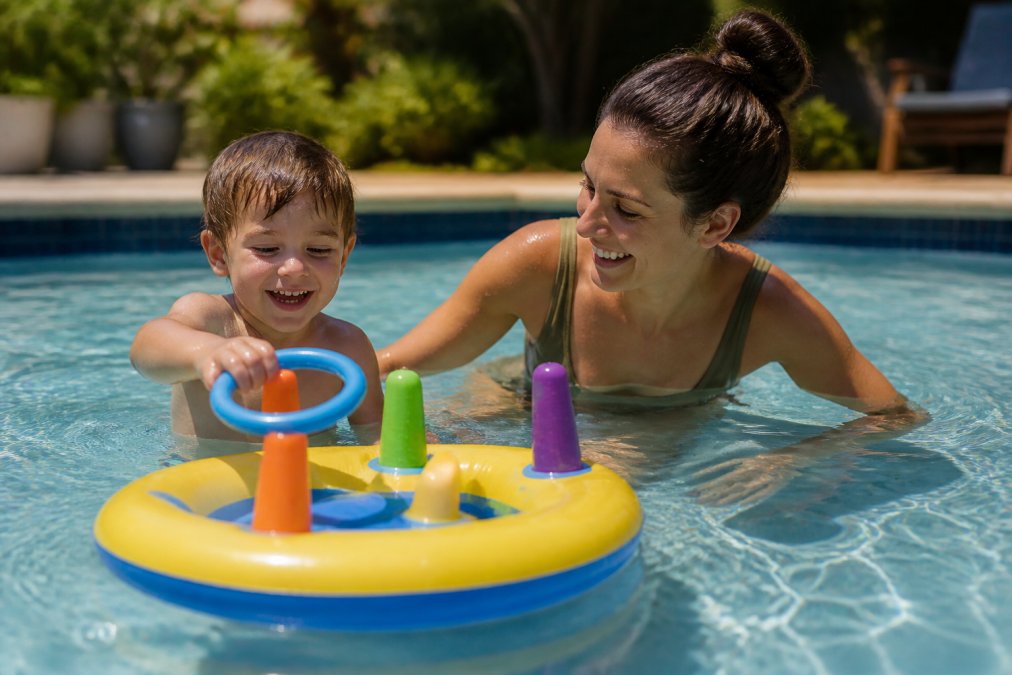
- Non-swimmers (feet on the floor, hands on you or the wall). Games must keep the head above water and the child within arm's reach. No throwing games that require chasing, no underwater retrieval.
- Emerging swimmers (can float on front and back with support, move a few metres). Games can include short face-in-water moments and gentle movement away from the wall, but the adult stays in the water.
- Confident beginners (can swim a few metres unaided, comfortable with face wet). Games can include simple retrieval from the bottom step and short relays, with the adult at the edge.
Games for non-swimmers
These need nothing but water, a wall, and you:
- Humpty Dumpty sits on the wall. Your child sits on the edge, sings the rhyme, and "falls" gently into your waiting arms. Repeat until the splash becomes the fun part. This builds the expectation that entering the water is safe and predictable.
- Blow the bubbles. Have your child blow at a floating ping-pong ball to move it across the surface. This teaches breath control without submersion, the most useful pre-swimming skill.
- Treasure at the steps. Place a colourful toy on the top step and let your toddler retrieve it while holding your hands. It introduces reaching underwater without a full submersion.
- Splash count. Count splashes out loud together. It works when a child is nervous about getting their face wet.
Games for emerging and confident beginners
Once your child is comfortable with their face wet and can move a little, add a target:
- Floating cornhole. RippleWave's Inflatable Frog Pool Cornhole Game (€22.99) has colour-coded pockets and three bean bags sized for small hands. The soft bean bags mean a miss doesn't sting, and the colour coding becomes a matching game for children not ready to keep score.
- Inflatable dart board and ring toss. RippleWave's Inflatable Dart Board Ball and Ring Toss Water Game (€18.99) fits this age group well. The soft fabric balls stick to the waterproof target, so misses feel like near-misses. It includes eight balls and twelve rings, and the base can be part-filled with water to stop it tipping in a breeze.
- Follow the leader. You walk the pool floor in a circle; your preschooler copies every move. Add a hop, a splash, a bubble-blowing stop. It builds water comfort through imitation.
Equipment-free options
At a public pool, a friend's house, or the beach, you don't want to carry a bag of toys. These need nothing but water and a willing adult:


- Simon Says, water edition. "Simon says touch the wall." "Simon says blow bubbles." "Simon says give me a high five." The format is already familiar, so the water version feels safe.
- Ring around the rosy. The classic circle game translates perfectly to the shallow end. The falling-down moment becomes a gentle splash, exactly the kind of controlled surprise that builds water confidence.
- Freeze splash. Everyone splashes until you call freeze, then holds still. The last one moving is out. It burns energy and teaches self-regulation.
Best Pool Games for School-Aged Children (Ages 6-12)
School-aged children want competition, scoring, and something that feels like a real sport, floating basketball, football toss, and diving games.
| Game | Age Range | Key Skill Built | Setup Time |
|---|---|---|---|
| Diving ring hunt | 6-12 | Breath control, underwater confidence | 5 min |
| Floating basketball | 6-12 | Hand-eye coordination, teamwork | 5 min |
| Football toss scoring | 6-12 | Aim, turn-taking | 10 min |
| Relay races | 6-12 | Motor skills, social interaction | 2 min |
Equipment-Free Pool Games for Young Children
Equipment-free pool games rescue a pool day when a ball has drifted over the fence, a ring has punctured, or you want the kids to burn energy without setup.
- Marco Polo. One player closes their eyes and calls "Marco"; the others answer "Polo" and move away. It teaches listening and spatial awareness.
- Simon Says, water edition. "Simon says touch the wall." "Simon says blow bubbles."
- Freeze splash. Everyone splashes until you call freeze, then holds still. The last one moving is out.
- Underwater countdown. How long can you hum a song with your face in the water? Start with two seconds and build up.
- Ring around the rosy. The classic circle game translates perfectly to the shallow end.
Sensory-Friendly Pool Games and Post-Pool Transitions
Sensory-friendly pool games suit children who find noise, splashing, or unpredictability overwhelming. The pool can be a wonderful sensory environment, but only if the intensity is dialled down.
What works:
- Slow-motion games. Play catch with a floating ball at half speed. Fewer splashes, same fun.
- Predictable routines. Same order every visit: steps, wall sits, bubbles, then a game. Predictability lowers anxiety.
- Weighted, quiet toys. Diving toys that sink slowly give a child something to track visually without chaos.
- One-on-one time. Fewer players means less noise and less crowding.
Frequently Asked Questions
What are the best pool games for toddlers to build water confidence?
Games that focus on fun and gradual exposure work best. Try 'Humpty Dumpty' where your child sits on the pool edge and 'falls' into your arms, or 'Ring Around the Rosie' in the shallow end. These pool games for young children teach breath control and getting faces wet without pressure. Blowing bubbles through a pool noodle also helps toddlers practice exhaling underwater, a key swimming skill.
How can I keep young children entertained safely in the pool?
Active supervision is non-negotiable. An adult should be within arm's reach of non-swimmers at all times. Structure play with short, varied pool games for young children like a 5-minute ring toss followed by a 5-minute floating race. This prevents boredom and keeps kids in the shallow end. Always designate a water watcher who isn't distracted by phones or conversation.
What are some simple pool games that require no equipment?
You can play 'Simon Says' with water actions like touching the bottom or floating on your back. 'Motorboat' races involve kids kicking while holding the wall. 'Treasure Hunt' uses imaginary objects they dive for. These equipment-free pool games for young children build motor skills and water comfort. They're perfect for when you want to avoid inflating toys or packing gear.
How do I choose age-appropriate pool games for preschoolers?
For ages 3-5, pick games with simple rules and short turns. Look for activities that keep them in the shallow end and focus on water confidence, like blowing bubbles or kicking with a kickboard. Avoid competitive games with complex scoring. The best pool games for young children at this age are ones that let them practice breath control and buoyancy without pressure.
Are there pool games that help young children learn to swim?
Yes. Diving for rings improves breath control and underwater exploration. 'Swim Thru' rings encourage submersion and forward movement. Toss games build hand-eye coordination while keeping kids active in the water. These interactive water games for beginners naturally develop swimming skills. Pair them with pool safety rules for families, like always swimming with a buddy, to reinforce safe habits.
Pool games for young children only work when the safety underneath them is solid. RippleWave stocks durable, family-friendly inflatable games built for exactly this: ring toss sets, floating basketball, diving rings, and cornhole boards that survive a full summer of use. Every order ships fast with tracking, arrives with no EU import duties, and comes in fully recyclable and biodegradable packaging. Browse the collection and turn your next pool day into the one the kids ask for again.


