


Table of Contents
- Understanding pool floats for small pools
- Float types: loungers, tubes, noodles, and alternatives
- Sizing your float: calculating spatial footprint
- Safety features and stability in shallow water
- How to maintain inflatable pool toys
- Inflatable pool toy storage solutions
- Choosing the right float for your family and pool
- Frequently Asked Questions
Last Updated: September 25, 2026
Understanding pool floats for small pools
Choosing the right pool floats small pools isn't just about grabbing whatever fits through the gate. Space matters. Stability matters. The wrong float can turn a relaxing afternoon into frustration, or worse, a safety issue in shallow water.
Small pools present unique challenges: shallower water depth, tighter surface area, and limited storage space all change which floats actually work.
Most people buy floats designed for Olympic-sized pools, then struggle to use them in compact spaces. This guide breaks down what actually works.
Why size and stability matter in compact spaces
In a small pool, an oversized float wobbles from poor weight distribution, consumes too much surface area, and is hard to inflate and store.
Stability is critical in shallow water. A float that sits too high will tip easily; poor weight distribution causes uncomfortable rocking and safety risks.
The solution is matching the float's dimensions to your actual pool size. Measure your water surface area first. Calculate how much space you actually have. Then choose a float that uses no more than 40-50% of that surface.
Key material differences: durability and puncture resistance
Not all inflatable pool toys are created equal. Material thickness directly impacts how long your float survives.
PVC (polyvinyl chloride) is affordable but thin versions puncture easily. Look for at least 0.3mm thickness for recreational use.
Vinyl blends cost more but offer better puncture resistance and reinforced seams, important in small pools where floats experience more friction.
Reinforced air chambers make a real difference. Multiple separate chambers mean one puncture doesn't deflate the entire float. This is especially important if you have children using the float unsupervised.
Check seam integrity before buying, poor seams are the most common failure point. Raised or rough seams indicate weak construction.
Float types: loungers, tubes, noodles, and alternatives
Different float types serve different purposes in small pools. Understanding the trade-offs helps you pick what actually works for your situation.
Loungers and saddle floats for small pools
Loungers are designed for relaxation and typically require 2-3 square meters, which may be too much for very small pools.
Saddle floats are better for compact spaces. You sit astride them with legs dangling, using less surface area than loungers while keeping your center of gravity low and reducing wobbling.
For small pools, saddle floats work best. They accommodate one person comfortably without consuming excessive space. Kids often find them more fun than loungers because they feel more interactive.
Weight capacity matters here. Most saddle floats support 100-150 kilograms. Check the manufacturer's specifications before buying if you're a heavier user.
Best alternatives to traditional pool noodles
Pool noodles are cheap but standard 1.4-meter versions are often too long for small pools, hitting walls and other swimmers.
Shorter noodles (0.9-1.1 meters) are easier to maneuver and avoid crowding issues.
Inflatable rings and donuts are smaller, more stable, and ideal for young children learning to swim, typically 0.6-0.9 meters in diameter.
Foam noodles don't puncture or need inflation, but take up more storage space than deflated inflatables.
Kickboards are underrated for small pools. They're compact, stable, and useful for swimming practice. A kickboard measures roughly 0.45 × 0.35 meters, making it ideal for tight spaces.
Sizing your float: calculating spatial footprint
This is where most people go wrong. They eyeball the pool and guess. Then the float arrives and doesn't fit the way they imagined.
Measuring water depth and surface area
Most pool floats small pools work best when the water is 1.0-1.5 meters deep. Floats with high centers of gravity are unstable at this depth; choose floats designed for shallow water.
Measure your pool's surface area in square meters. Length × width = surface area. For example, a 3m × 4m pool is 12 square meters.
A standard lounger uses 2-3 square meters, a saddle float uses 1-1.5 square meters, and a noodle uses 0.2-0.3 square meters.
The rule: your float should occupy no more than 40-50% of your total surface area. If your pool is 12 square meters, your float should use 4.8-6 square meters maximum. This leaves room for actual swimming.
Weight capacity and buoyancy for different ages
Buoyancy depends on air volume and material density. Larger air chambers provide more buoyancy; thicker materials reduce it slightly but improve durability.
For young children (ages 3-6), choose floats supporting 30-50 kilograms, smaller, lighter, and easier to grip.
For older children and adults (ages 7+), standard floats support 100-150 kilograms. These work for most recreational use.
If you're buying for mixed ages, choose floats with weight capacity of at least 120 kilograms. This ensures safety even if a heavier child or adult uses it.
Safety features and stability in shallow water
Shallow water changes the safety equation. Your float can't rely on deep water to absorb impact. Stability becomes everything.
Center of gravity and wobbling prevention
A float's center of gravity determines stability. In shallow water, a high center of gravity is dangerous, causing tips into water users can't stand in.
Choose floats with low, wide profiles, wider bases lower the center of gravity and improve stability.
Multiple air chambers distribute weight evenly; single-chamber floats shift weight when you move, causing wobbling.
Test stability before buying if possible. Does it rock when you shift weight? If not, skip it.
Safety valves and air chamber design
A safety valve prevents over-inflation, which causes rigidity and seam failure. A good valve opens automatically if pressure gets too high.
Multiple air chambers are critical for safety. If one chamber leaks, the others keep the float buoyant. Single-chamber floats lose all flotation from one puncture.
Check the valve design. Screw-type valves are most reliable. Push-in valves are cheaper but fail more often. Avoid floats with unclear valve mechanisms.
For children, choose floats with dual air chambers minimum. This provides a safety margin if one chamber develops a slow leak.
How to maintain inflatable pool toys
Maintenance extends the life of your floats significantly. Neglect, and a float that should last three years fails in one.
Cleaning and pool chemistry compatibility
After each use, rinse floats with fresh water to remove chemical residue that degrades PVC.
Use mild soap and soft brushes for stubborn dirt; avoid harsh chemicals and rough scrubbing.
Maintain proper pH (7.2-7.6) and chlorine levels (1-3 ppm). High chlorine and low pH degrade materials and weaken seams.
Salt pools are harder on inflatables than chlorine pools. If you have a salt system, rinse floats more frequently and consider storing them indoors during off-season.
Checking seam integrity and preventing punctures
Inspect seams monthly during swimming season. Run your fingers along every seam. Feel for raised edges, cracks, or separation. Small issues caught early are cheap to fix. Ignored seams become major leaks.
Prevent punctures by keeping your pool clear of sharp objects. Remove leaves, twigs, and debris regularly. Rough pool surfaces (concrete with cracks, sharp tile edges) damage floats. If your pool has rough spots, consider using a pool liner or padding to protect floats.
Store floats away from direct sunlight when not in use. UV rays degrade PVC. Even a few hours of intense sun daily accelerates material breakdown.
Inflatable pool toy storage solutions
Storage is where most small-pool owners struggle. Floats take up space. Damp floats develop mold. Poor storage shortens float lifespan.
Compact storage for small backyards
The best storage is dry, cool, and out of direct sunlight. A garden shed works perfectly. A garage corner works. A sealed storage box works. Avoid attics (too hot) and damp basements (mold risk).
Deflate completely before storage. A deflated float takes 10% of the space of an inflated one.
Deflation and off-season care
Deflate your floats before winter or extended off-season storage. Pressure builds up in stored floats, stressing seams. Deflated floats avoid this problem.
Choosing the right float for your family and pool
The final decision depends on your family's needs and your pool's constraints.
Matching floats to age and swimming ability
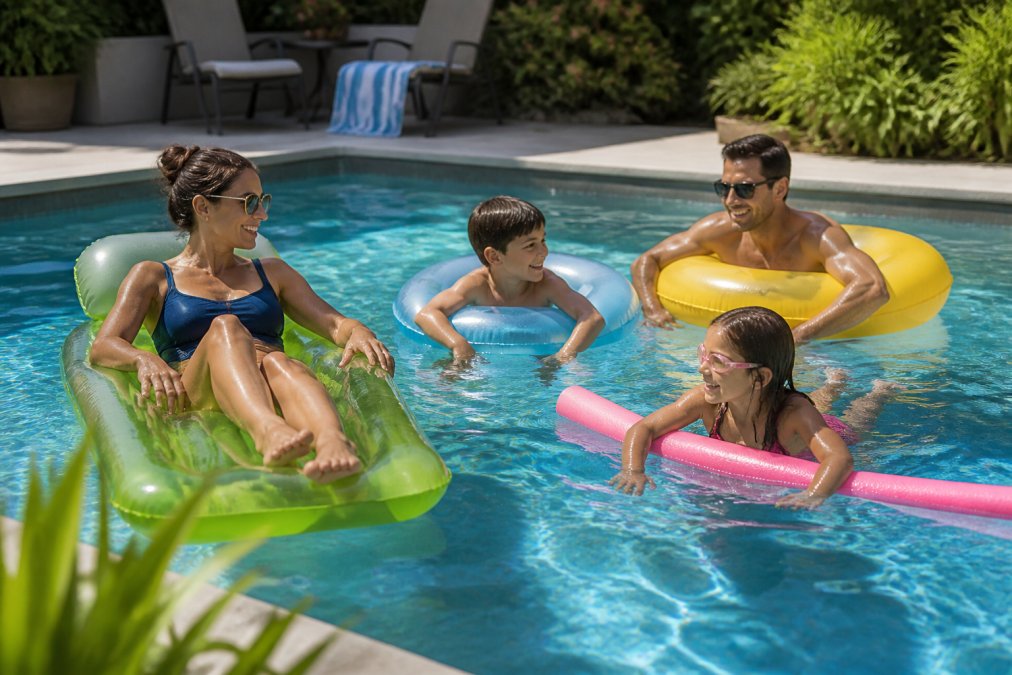
Young children (ages 3-5) need floats with high buoyancy and low centers of gravity. Avoid loungers, they're unstable for this age group. Choose saddle floats, rings, or purpose-built children's floats. These keep kids upright and secure.
UV protection and canopy options
Sun exposure damages floats. UV rays degrade PVC. Extended sun exposure can reduce float lifespan by 50%.
Frequently Asked Questions
How do I measure a pool float for a small pool?
Measure your pool's length, width, and water depth in centimetres. Calculate surface area (length × width) and divide by the number of people using floats simultaneously. A lounger typically needs 1.5-2 square metres of space, while a noodle or tube needs 0.3-0.5 square metres. Check the float's weight capacity against your body weight plus 20%, and ensure water depth accommodates the float's bottom clearance without touching the pool floor.
What materials are most durable for pool floats in smaller pools?
PVC and reinforced vinyl offer the best puncture resistance for small pools where floats may contact pool edges or rough surfaces more frequently. Look for floats with multiple air chambers, as they prevent total deflation if one chamber fails. Thicker material (0.6-0.9 mm) lasts longer than thin vinyl. Check seam integrity and safety valve quality, double-stitched seams resist punctures better.
What are the best space-saving alternatives to traditional pool noodles?
Compact saddle floats, inflatable rings, and mini loungers offer more stability than noodles in the same footprint. Segmented noodles can be broken apart or used individually. Inflatable water pillows compress flat for storage. Tanning ledge floats grip pool edges without floating freely, saving central space. Floating game tables and saddle floats provide dual function, lounging and activity, reducing the number of separate floats needed in tight spaces.
How can I store inflatable pool floats efficiently in a small backyard?
Deflate floats completely and store in airtight bags or sealed containers to prevent moisture and mildew. Stack deflated loungers and tubes vertically in compact storage bins. Use wall-mounted organizers or hanging nets to free up floor space. Store in a cool, dry location away from direct sunlight. Keep safety valves and inflation plugs together in a labelled bag. Ensure storage area has good ventilation to prevent odour and degradation.


