


Table of Contents
- Inflatable vs Hard Plastic Pool Games: Key Differences
- Material Quality and Durability Under Real-World Use
- Setup, Portability, and Storage Footprint
- Inflatable vs Hard Plastic Pool Toys: Maintenance and Cleaning
- Safety and Supervision by Age and Activity
- Inflatable Pool Toy Repair and Longevity
- Pool Games for Small Pools: What Works Best
- Total Cost of Ownership
- Frequently Asked Questions
Last Updated: October 6, 2026
Inflatable vs Hard Plastic Pool Games: Key Differences
When comparing inflatable vs hard plastic pool games, the choice looks straightforward until you start using them. One deflates after three weeks; the other cracks in the sun. One takes 20 minutes to set up; the other sits ready to go.
Quick Comparison Table
| Feature | Inflatable Games | Hard Plastic Games | Winner for Most |
|---|---|---|---|
| Setup Time | 15-30 minutes | Instant (no inflation) | Hard plastic |
| Durability (seasons) | 1-2 seasons | 3-5+ seasons | Hard plastic |
| Storage Footprint | Compact when deflated | Bulky year-round | Inflatable |
| Repair Difficulty | Patch kits available | Cracks are permanent | Inflatable |
| Price Entry Point | €20-€250 | €30-€400 | Inflatable |
| Maintenance | Regular cleaning, mold watch | Rinse and store | Hard plastic |
| Portability | Easy to transport | Heavy, requires space | Inflatable |
| Age Suitability | All ages (with supervision) | Better for older kids | Depends on game |
Material Quality and Durability Under Real-World Use
Hard plastic games win on longevity. A rigid ring toss base or basketball hoop can survive multiple seasons of sun, chlorine, and careless storage.
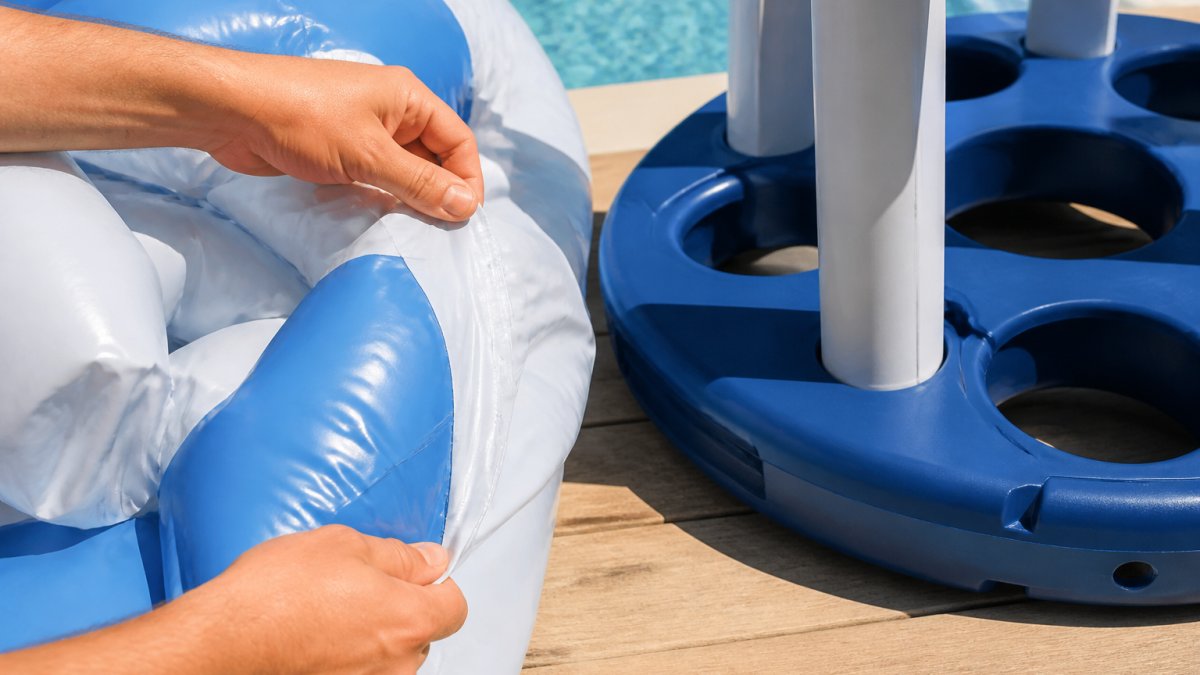
But repair changes the calculation. When hard plastic cracks, it's done. When an inflatable develops a small leak, you patch it and keep playing, more forgiving in practice.
The RippleWave Floating Mahjong Table uses premium EVA foam, which resists water damage.
Setup, Portability, and Storage Footprint
This is where the two types diverge most. Hard plastic games are ready the moment you pull them out, no pump, no waiting.
Inflatable games demand preparation. The RippleWave Inflatable Ring Toss Game needs inflation before each use.
Storage tells a different story. Inflatables deflate to a fraction of their size and fit in a bag or closet; hard plastic stays bulky year-round.
Inflatable vs Hard Plastic Pool Toys: Maintenance and Cleaning
Hard plastic games are maintenance-simple: rinse with fresh water, dry, store. No special care, no mold risk.
Inflatable games demand more attention. Rinse with fresh water after use to prevent chlorine buildup and mold inside seams.
Proper care extends inflatable lifespan significantly: store clean and completely dry, keep out of direct sunlight, and check seams regularly for leaks.
Safety and Supervision by Age and Activity
Safety is the one area where the inflatable-versus-hard-plastic choice is not a matter of preference. The two formats fail in different ways, mapping onto different age groups and pool conditions. Compare them across four risk categories: stability, slipping, entrapment, and deflation or structural failure.
Stability and tipping
Hard plastic games are bottom-heavy by design. A rigid ring-toss base or basketball hoop sits on a wide footprint and doesn't shift when a child leans on it.
Inflatable games are buoyancy-dependent. A floating ring-toss set or mahjong table moves with every ripple, fine for a confident swimmer, but a poor match for a child still learning to balance in water.
Slipping and hard edges
Hard plastic games have moulded edges and smooth surfaces. Wet plastic is slippery, and a child stepping on a rigid base to reach a hoop can lose footing.
Inflatable games have soft edges, removing the cut risk but introducing another: a wet PVC or nylon surface is also slippery, and a child climbing onto an inflatable from the water can slide off and strike the pool wall.
Entrapment and entanglement
This risk category is most often overlooked. Inflatable ropes, tethers, handles, or inflation valves can create loops a small child could catch an arm or leg in, check every strap and cord, and cut or tape down anything that forms a loop. Hard plastic rarely has this problem, but hollow bases and drainage holes can trap small fingers.
Deflation and structural failure
An inflatable that loses air mid-play can dump a child into the water unexpectedly, the strongest argument for hard plastic around non-swimmers. A puncture or split seam doesn't announce itself; the game softens and submerges. Hard plastic fails differently: a crack propagates slowly and is usually visible before it becomes a hazard.
Age and activity guidance
- Under 3: Neither format is a substitute for arm's-reach supervision. Hard plastic games with no small detachable parts are the lower-risk option because they cannot deflate.
- Ages 3-6: Hard plastic games with wide, stable bases work well in shallow water. Inflatables are acceptable only in water shallow enough for the child to stand, and only with an adult within arm's reach.
- Ages 6-12: Both formats are viable. Inflatables become safer as swimming competence improves, but group play on a single inflatable should be limited to the number of players the manufacturer specifies.
- Teens and adults: Inflatable games handle rougher play and are generally more forgiving of contact. Hard plastic games are better for competitive or score-based play where a stable target matters.
Water depth and supervision
A practical rule: match the game to the depth. Floating inflatables belong in water deep enough to float freely but shallow enough for a non-swimmer to stand.
Supervision requirements don't change with the format. Both need an adult watching the water, not the phone, plus a pre-use check: inflatables for air loss, seam stress, and loose tethers; hard plastic for cracks, sharp edges, and stability.
What to check before every session
- Inflate to the manufacturer's recommended firmness, over-inflation stresses seams, under-inflation makes the game unstable.
- Inspect seams, valves, and tethers on inflatables; inspect rims, bases, and moulding on hard plastic.
- Confirm the game is rated for the number of children who will actually use it.
- Position hard plastic games on flat, non-slip ground away from the pool edge.
- Keep a reaching pole and a phone within arm's reach of the supervising adult.
For households with mixed ages, the safest setup is often a hard plastic game in the shallow end for younger children and a separate inflatable in the deeper section for older ones, two zones, two supervision points.
Inflatable Pool Toy Repair and Longevity
Inflatable games come with repair potential hard plastic doesn't have.
Seam leaks are trickier. You can patch a split seam, but the repair is less reliable than fixing a puncture because seams are structural.
Hard plastic fails differently: cracks spread.
Floating Mahjong Table for Pool, 31.5" EVA Double Sided with Bag →
For families who repair and maintain equipment, inflatables offer value extension.
Pool Games for Small Pools: What Works Best
Small pools pose unique challenges: less water to absorb a game's footprint, and large inflatables can dominate the space. Hard plastic games often fit better because they're compact.
Inflatable games can work in small pools, but choose carefully. Avoid large inflatables like slides and opt for smaller ones like the RippleWave Inflatable Ring Toss Game, which inflates to a manageable size.
Total Cost of Ownership
Purchase price is the least useful number here. What matters over a realistic five-year horizon is total cost of ownership: the game, its accessories, repairs, storage space, and disposal.
Purchase price
Entry-level inflatables sit in the €20-€60 range; entry-level hard plastic in the €30-€80 range. Premium inflatables, slides, large floating tables, multi-player sets, run roughly €150 to €300, while premium hard plastic sets rarely exceed €150.
On day one, inflatables usually win on price. That advantage shrinks fast.
Accessories you will actually need
- Inflatable games: a pump is effectively mandatory. Manual pumps cost €10-€25; electric pumps €25-€60. Patch kits run €5-€15 and you will likely buy more than one. A storage bag is often included but a better one costs €10-€20.
- Hard plastic games: usually nothing beyond what is in the box. Some sets benefit from a ground mat or non-slip pad, €10-€30.
Accessories can add 30-60% to the first-year cost of an inflatable setup, the single most under-reported number in this category.
Repairs and replacement frequency
Inflatables commonly last one to two seasons in regular use; hard plastic three to five, sometimes longer if stored out of direct sun. Over five years, inflatable owners may buy the same game multiple times, while hard plastic owners may buy once.
Run the arithmetic on a mid-range example:
| Cost line | Inflatable (5 years) | Hard plastic (5 years) |
|---|---|---|
| Initial purchase | €40 | €60 |
| Pump | €25 | €0 |
| Patch kits | €20 | €0 |
| Replacements | €80 (two more units) | €0 |
| Storage | €15 (bag) | €0 |
| Disposal | €0-€10 | €0-€10 |
| Approximate total | €180-€190 | €60-€70 |
Storage cost
Storage is a real cost even when it doesn't appear on a receipt.
If you pay for storage, or your garage or shed is already full, that footprint has value. In a typical Finnish apartment or rowhouse with limited outdoor storage, the inflatable's packability can be worth more than the price difference.
Energy and water
Inflatable games add a small electricity cost with an electric pump, and both formats use water for rinsing. Neither is significant at household scale, but the inflatable's pump is the only recurring energy draw.
Disposal and end-of-life
This is where the comparison gets uncomfortable. Hard plastic games are bulky and made of mixed materials, making them difficult to recycle and expensive to transport to a waste facility.
A practical approach for both formats:
- Check whether your municipality accepts the item as bulky waste or at a sorting station.
- If the game is still functional, pass it on rather than bin it. Second-hand marketplaces move pool games quickly in early summer.
- If it is beyond use, cut inflatables into smaller pieces only if your waste guidance allows it; otherwise take them to the appropriate collection point.
Neither format is a strong environmental performer. The lower-impact choice is the one you keep longer, which favours hard plastic on lifespan and inflatables on material volume.
Resale value
Hard plastic holds resale value better because it's more likely to survive intact.
The bottom line on cost
If you want the lowest five-year cost and have storage space, hard plastic wins. If you have limited storage, want variety, or expect to change games as your children grow, the inflatable's lower entry price and packability can still make sense, but budget for a pump, patch kits, and at least one replacement.
For households wanting both durability and variety, the most cost-effective pattern is one hard plastic game as the permanent fixture and one inflatable as the rotating seasonal extra, rather than replacing inflatables year after year.
Frequently Asked Questions
Are inflatable or hard plastic water games more durable?
Hard plastic games typically outlast inflatables when used regularly. Rigid EVA or plastic bases resist punctures, UV damage, and material fatigue. Inflatables last multiple seasons with proper care; hard plastic games often perform for multiple years. However, durability depends on material quality, storage practices, and maintenance. Premium inflatables with reinforced seams can match or exceed budget hard plastic options in real-world conditions.
Which pool games are easier to store?
Hard plastic games win for storage convenience. Rigid bases stack compactly and take up minimal space year-round. Inflatables require deflation, which takes 10-20 minutes per item, then need dry storage to prevent mold. If you lack storage space or want instant setup, hard plastic games are faster. For seasonal use in tight spaces, inflatables save room when properly dried and stored in breathable bags or sealed containers.
How do you repair a punctured inflatable pool toy?
Most punctures in inflatable pool toys can be patched using a vinyl repair kit. Locate the hole by inflating and listening for hissing, or apply soapy water to spot bubbles. Clean and dry the area, apply adhesive from the repair kit, and press the patch firmly for 24 hours. For seam leaks or large tears, professional repair or replacement is more cost-effective. Prevention is key: inspect toys regularly, store in cool conditions, and avoid sharp pool edges.
Which type of pool game is better for small pools?
Hard plastic games excel in compact spaces because they're fixed-size and stable. The Pool Ring Toss Toys with EVA base (€37.99) takes minimal space. Inflatables can be deflated to fit tight storage, but some large inflatables require more water when deployed. For small pools, choose games with low water requirements and compact bases, or select inflatables you can deflate after each use rather than permanent installations.
What makes one pool game option better than another for families with young children?
Age suitability is critical. Hard plastic games like ring toss are safer for toddlers because they have no sharp seams or inflation risks. Inflatables work well for ages 5+. Supervision matters equally for both types. Hard plastic games offer faster setup (no inflation), which is valuable when managing multiple young children. Inflatable games develop hand-eye coordination and are lighter if children need to move them, but require adult inflation and monitoring for leaks.


