


Table of Contents
- How Long Do Biodegradable Pool Toys Last? The Short Answer
- Eco-Friendly Pool Toy Materials: What They're Made Of and How They Age
- What Shortens the Life of Biodegradable Pool Toys
- How to Store Pool Toys for Winter (and Keep Them Longer)
- How to Recycle Inflatable Pool Toys and Dispose of Worn-Out Ones
- Biodegradable vs. Traditional Plastic Pool Toys: Durability and Environmental Impact
- Conclusion: Getting the Most Out of Your Biodegradable Pool Toys
- Frequently Asked Questions
Last Updated: September 29, 2026
How Long Do Biodegradable Pool Toys Last? The Short Answer
Most biodegradable pool toys last one to three seasons with careful use and storage. That range covers everything from thin latex splash balls to thicker natural rubber rings. How long your biodegradable pool toys last depends on the material, how often they hit the water, and how you store them.
At RippleWave, we hear this question a lot from families who want fun that does not cost the planet. The honest answer: eco-friendly toys can rival plastic ones when you treat them well.
Below, we break down real lifespans by material, what wears them out, and how to stretch every season.
Typical Lifespan by Material Type
Lifespan varies widely by material. Here is what to expect:
| Material | Typical Lifespan | Best For | Main Weakness |
|---|---|---|---|
| Natural rubber | 2-3 seasons | Rings, balls | Heavy sun exposure |
| Latex | 1-2 seasons | Small toys | Punctures |
| Biodegradable polymers | 1-2 seasons | Floats, games | Chlorine wear |
| Natural cork | 3+ seasons | Floats, boards | Drying out |
Natural rubber holds up best. Latex is softer but tears faster. Biodegradable polymers sit in the middle.
Eco-Friendly Pool Toy Materials: What They're Made Of and How They Age
Eco-friendly pool toy materials fall into two camps: plant-based rubber and compostable polymers. Each ages differently in water and sun.
Natural rubber comes from tree sap. It stretches well and resists punctures. But UV exposure breaks it down over time.
Latex is similar but thinner. It feels softer and works great for small toys. It also tears more easily.
Biodegradable polymers are man-made but break down in compost. They handle water well but react to chlorine.
Natural cork floats forever if you dry it properly. It is the most durable plant-based option.
Natural Rubber, Latex, and Biodegradable Polymers Compared
Here is how the three main materials stack up:
- Natural rubber: Best durability, needs shade, repels water
- Latex: Softest feel, shortest life, cheap to replace
- Biodegradable polymers: Good all-rounder, sensitive to pool chemicals
A common mistake is treating all three the same. Latex toys need gentler handling than rubber. Polymers need rinsing after every swim.
What Shortens the Life of Biodegradable Pool Toys
Three things kill biodegradable pool toys faster than anything else: chlorine and pH, UV exposure, and material fatigue. The first is the one almost no guide explains, and it is the one that matters most in a pool.
Chlorine and pH: The Breakdown Mechanism
Free chlorine is an oxidising agent. In a pool it attacks the double bonds in natural rubber and the ester linkages in most biodegradable polymers, the same bonds that give the material its stretch. Every hour a toy floats in treated water, those chains shorten. The toy does not fail suddenly; it goes from springy to chalky to cracked over a few weeks.
- Free chlorine at 1-3 mg/l (the usual range for a public or domestic pool): noticeable surface dulling within 2-3 weeks of daily use, seam failure within one season.
- Free chlorine above 5 mg/l (shock treatment): a single overnight soak can halve the remaining life of a thin latex toy.
- pH outside 7.2-7.6: alkaline water (pH above 8) softens natural rubber faster; acidic water (below 7) attacks the plasticiser in biopolymer blends.
This is why the same toy that lasts three seasons in a lake or a paddling pool lasts one in a chlorinated pool. The water chemistry, not the toy, is the variable.
UV Exposure
Ultraviolet light breaks the carbon-carbon backbone of rubber and latex. In practice, a toy left on the pool deck in full sun for a full summer can lose roughly half its usable life compared with one stored in shade between swims. The damage shows as a dry, powdery surface and hairline cracks that open the first time the toy is stretched.
Material Fatigue
Every inflation and deflation cycle stresses the seams and valve seat. Valves are usually the first failure point on rings and floats, not the body of the toy. Toys that stay inflated through the season outlast toys that are pumped up and flattened every weekend.
What This Means for Lifespan
Stack the three factors and the realistic range becomes clear:
| Condition | Natural rubber | Latex | Biopolymer |
|---|---|---|---|
| Chlorinated pool, stored dry | 2 seasons | 1 season | 1-2 seasons |
| Chlorinated pool, left in water | 1 season | under 1 season | under 1 season |
| Fresh or salt water, stored dry | 3+ seasons | 2 seasons | 2-3 seasons |
If you want the longest life from a biodegradable toy, keep it out of the water between swims, keep it out of direct sun, and keep it inflated.
How to Store Pool Toys for Winter (and Keep Them Longer)
Storing pool toys for winter is the single best way to add years to their life. Cold, damp storage ruins them. Dry, dark storage saves them.
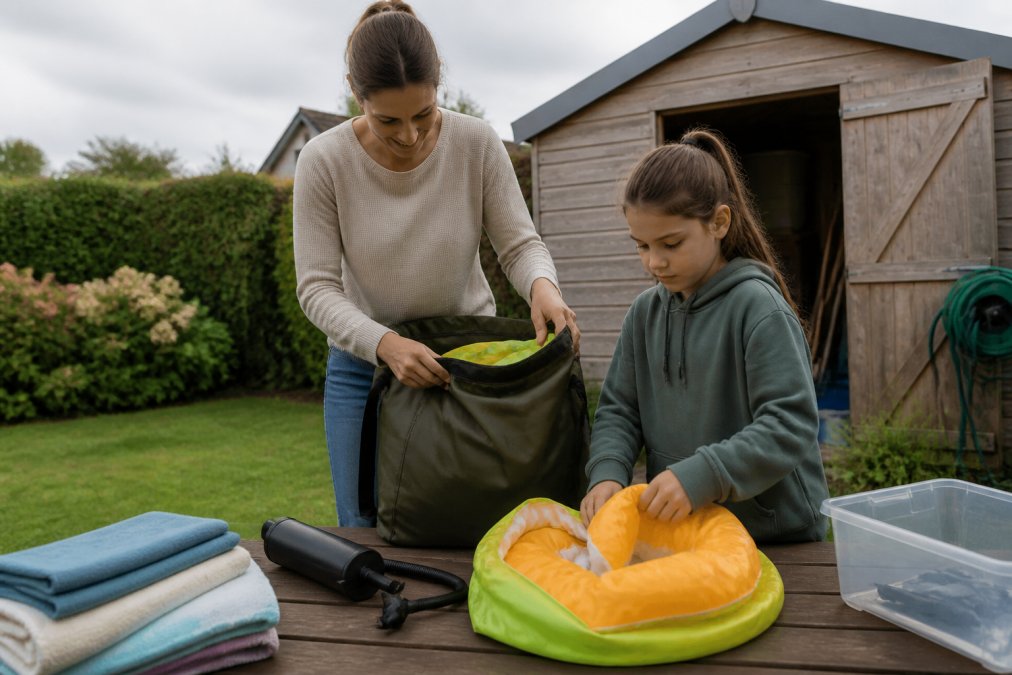
Follow these steps:
- Rinse every toy in fresh water to remove chlorine.
- Dry fully in the shade, not direct sun.
- Deflate completely and fold loosely.
- Store in a cool, dry place away from sunlight.
- Add a moisture absorber to the storage box.
Skip any step and mold or cracking follows. The drying step matters most.
Store natural rubber and latex toys with a light dusting of talc-free powder. It stops the surfaces from sticking and cracking during months in storage.
How to Recycle Inflatable Pool Toys and Dispose of Worn-Out Ones
Recycling inflatable pool toys is tricky because most are mixed materials, and 'biodegradable' on a label does not tell you where the toy can actually go. The distinction that matters is home-compostable versus industrially compostable, and most biodegradable pool toys fall into the second category.
Home-Compostable vs. Industrially Compostable
- Home-compostable means the material breaks down in a garden compost heap at ambient temperatures, typically within 6-12 months. Pure natural rubber, uncoloured latex and natural cork generally qualify.
- Industrially compostable means the material needs the sustained heat and controlled conditions of a commercial facility, usually 55-60 °C, to break down in the advertised timeframe. Most biodegradable polymers used in pool toys are in this group. In a home compost heap they may sit largely intact for years.
- 'Biodegradable' with no qualifier is the weakest claim. It only means the material will eventually break down, with no timeframe and no guarantee about the conditions. Treat it as landfill-bound unless the packaging names a standard.
If the label does not state home-compostable, assume the toy needs an industrial facility.
How to Handle Each Material
- Natural rubber: Cut into strips, compost at home or via a green waste service.
- Latex: Same as rubber if uncoloured and unpainted.
- Biodegradable polymers: Check for a compostability certification, then send to an industrial composting facility, not the home heap.
- Natural cork: Reuse or compost.
- Mixed materials (fabric covers, plastic valves, printed inks): Remove the non-compostable parts first. Take the remainder to a recycling centre that accepts soft plastics.
What to Do With a Toy That Is Past Saving
Never burn them. Burning rubber and biopolymer blends releases harmful fumes.
If no composting route is available, the next best option is mechanical reuse: cut the toy into patches, garden ties or kneeling pads.
The best disposal is reuse, and the second best is the correct compost stream. A toy marked 'biodegradable' that ends up in a home compost heap it cannot break down in is no better than landfill, the label only works if the toy reaches the right facility.
Biodegradable vs. Traditional Plastic Pool Toys: Durability and Environmental Impact
Traditional plastic toys often last longer on paper. But their environmental footprint is far worse. They sit in landfills for centuries.
Conclusion: Getting the Most Out of Your Biodegradable Pool Toys
Biodegradable pool toys can last two to three seasons with the right care. Rinse them, dry them, store them well, and they will reward you.
Frequently Asked Questions
How long do biodegradable pool toys last compared to traditional plastic ones?
Biodegradable pool toys typically last one to two seasons with regular use, while traditional PVC inflatables often last two to three seasons. The gap comes down to material composition: natural rubber and latex break down faster when exposed to chlorine and UV light, whereas synthetic polymers resist degradation longer. Proper storage and rinsing after each use can push a biodegradable toy toward the upper end of that range.
Do biodegradable pool toys break down in chlorinated water?
Yes, chlorinated water speeds up the breakdown of biodegradable pool toys. Chlorine attacks the molecular bonds in natural rubber and latex, causing them to lose elasticity and develop cracks faster than they would in fresh water. Rinsing toys with clean water after every pool session removes chlorine residue and can add weeks or months to their usable life.
What is the best way to dispose of worn-out pool toys?
Check whether the toy is truly compostable or only biodegradable, as the two are not the same. Compostable toys can go into a home compost bin or a municipal biowaste collection point. Biodegradable but non-compostable toys belong in mixed waste unless your local recycling centre accepts soft plastics. Never leave worn-out inflatables in nature, as even biodegradable materials take months to break down in soil or water.
How should I store biodegradable pool toys to extend their life?
Rinse each toy with fresh water and let it dry completely before storing. Fold loosely rather than compressing tightly, and keep everything in a cool, dark, dry place such as a garage shelf or storage box. Avoid hot attics or damp cellars, as heat degrades rubber and moisture encourages mould. Storing pool toys for winter this way can add a full extra season of use.


