


Table of Contents
- Why Float Size Matters More Than You Think
- How to Check Size of Inflatable Pool Floats Before You Buy
- Height-Based Sizing: Matching Inflatable Pool Floats to Your Body
- Weight Capacity of Pool Floats: How to Read It Correctly
- Pool Size-to-Float Ratio: Matching Float Footprint to Your Pool
- Material Thickness, Valve Types, and Inflation Volume Requirements
- Best Alternatives to Traditional Pool Noodles for Every Pool Size
- Storage, Maintenance, and Seasonal Care for Inflatables
Last Updated: August 26, 2026
Why Float Size Matters More Than You Think
Buying inflatable pool floats online without checking dimensions is a common mistake. You order what looks like a generous lounger and it arrives undersized. Float size affects three critical factors: comfort (legs hanging off defeats lounging), pool fit (oversized floats restrict swimmer movement), and safety (particularly for children). Sizing correctly is straightforward once you know what to measure and what product specs actually mean.
How to Check Size of Inflatable Pool Floats Before You Buy
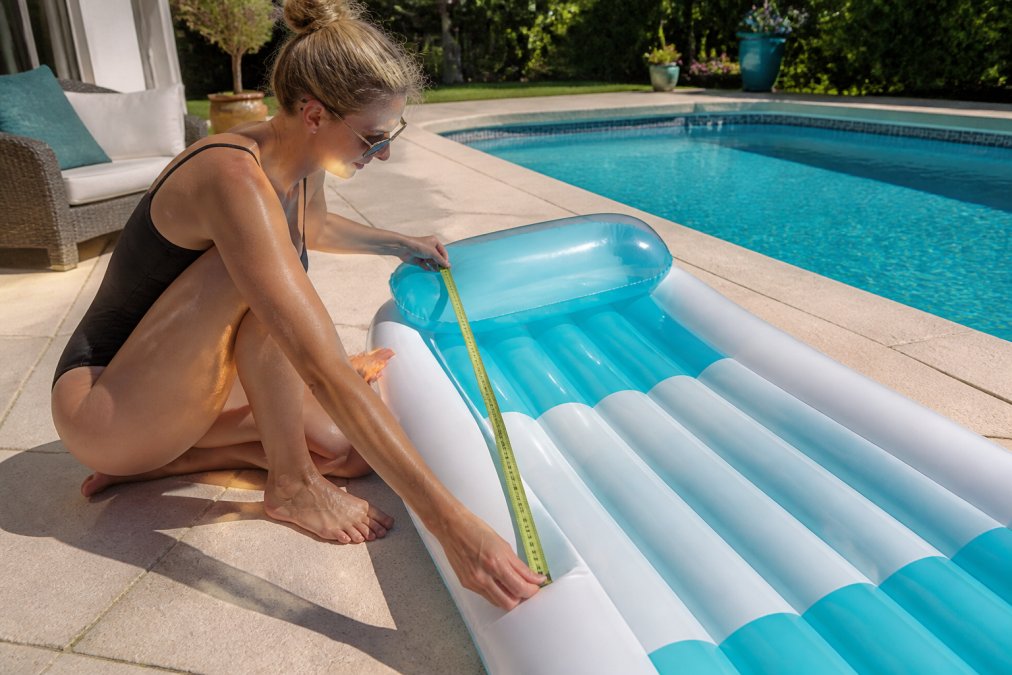
Checking float size comes down to two numbers: the inflated dimensions on the product page and the actual footprint in your pool. Start with the product listing and look for inflated length and width, not box dimensions. Many listings bury inflated size in secondary tables or list only deflated size. If you cannot find inflated dimensions explicitly stated, contact the retailer before buying.
Inflated vs. Deflated Dimensions: What the Spec Sheet Is Actually Telling You
Inflated dimensions are the measurements when the float is fully pumped up and in use. These matter for pool fit and body sizing.
Deflated dimensions describe the flat, packaged product. These are useful only for shipping and storage.
The difference can be significant. A float packing down to 60 × 40 cm might inflate to 200 × 100 cm. Always look for the phrase "inflated size" or "inflated dimensions" in specifications. If neither appears, check product images for scale reference or contact the seller. For novelty floats (flamingos, unicorns, pizza slices), look specifically at seating area dimensions rather than overall product dimensions, as these have irregular shapes.
How to Measure a Float Once It Is Inflated
Inflate fully and measure with a soft tape measure or string. For loungers, measure full length end-to-end, width at the widest point, and note the flat lying surface separately if there are raised headrests or foot bumpers. For ring floats, measure outer and inner diameter, the inner diameter determines whether an adult or child fits comfortably.
Height-Based Sizing: Matching Inflatable Pool Floats to Your Body
A general sizing framework based on user height:
| User Height | Recommended Float Length | Notes |
|---|---|---|
| Under 120 cm (children) | 100-140 cm | Kids' specific designs with safety features |
| 120-160 cm | 160-180 cm | Comfortable for most lounging positions |
| 160-180 cm | 180-210 cm | Full recline without legs hanging off |
| Over 180 cm | 210 cm or longer | Look for adult-sized or XL designations |
Sizing for Full Recline vs. Upright Reading Position
For full recline, your float should be at least as long as your height, ideally 10-15 cm longer. This allows your head to rest on a raised section while your feet remain fully supported. A float exactly your height leaves feet unsupported at the edge, causing tipping.
For upright reading, you can use a shorter float since legs bend at the knee. A float roughly 80% of your height works well. Width matters more here for a stable seated platform.
Sizing Kids' Inflatables by Age and Height
Children's inflatables prioritize safety over comfort. According to Finnish Consumer Safety Act guidance on children's water products, age-appropriate sizing and weight limits are primary safety considerations.
For children under 3 years: seat-ring floats with canopy covers and leg holes, typically supporting up to 15 kg.
For children aged 3-6: floats in the 100-130 cm range with handles or grip points for shallow water use.
For children aged 6-12: standard kids' loungers in the 130-160 cm range, with height-based sizing at 10-20 cm reduction from adult sizing.
Never use adult-sized floats for young children. Large floats are harder to control, tip more easily, and provide less support around smaller bodies.
Weight Capacity of Pool Floats: How to Read It Correctly
Weight capacity is the maximum load the float supports while maintaining safe buoyancy. The listed capacity is the engineering maximum, not the comfortable working load. Use floats at no more than 80% of their rated capacity for stable, comfortable use.
| Listed Weight Capacity | Comfortable Working Load | Best For |
|---|---|---|
| Up to 40 kg | Up to 32 kg | Children under 10 |
| 40-80 kg | 32-64 kg | Older children and lighter adults |
| 80-120 kg | 64-96 kg | Most adults |
| 120 kg and above | Up to 96 kg+ | Larger adults or tandem floats |
For tandem floats, check whether capacity is per person or total. Many listings are ambiguous. If it says "2-person float, capacity 120 kg," that is 60 kg per person, below average adult weight.
Pool Size-to-Float Ratio: Matching Float Footprint to Your Pool
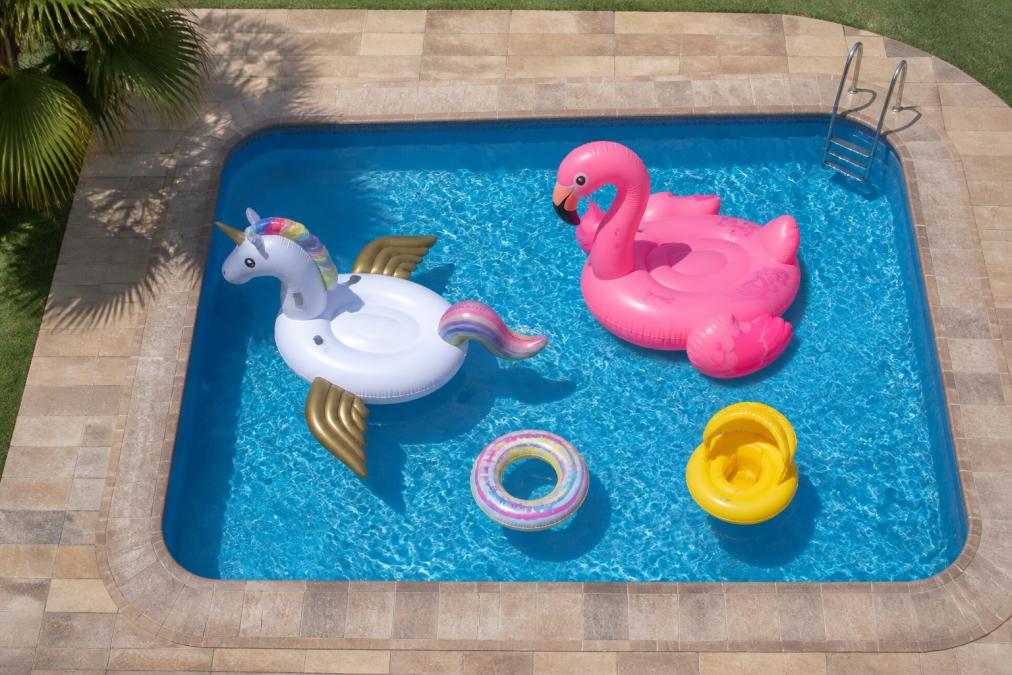
Floats should occupy no more than 30-40% of the pool's surface area at any time. Beyond that threshold, swimmers have limited room to move and collision risk increases.
Quick Pool Size-to-Float Ratio Calculator
- Calculate pool surface area: Multiply length × width for rectangular pools. For oval pools, multiply length × width × 0.78. For circular pools, multiply radius × radius × 3.14.
- Calculate usable float area (30% rule): Multiply pool surface area by 0.30.
- Calculate float footprint: Multiply the float's inflated length × inflated width.
- Divide: Usable float area ÷ float footprint = maximum number of floats.
Example: A 6 m × 3 m pool has 18 m² surface area. Usable float area at 30% is 5.4 m². A standard adult lounger at 2.0 m × 0.9 m has 1.8 m² footprint. Divide 5.4 by 1.8 to get 3 floats as comfortable maximum. Account for swimmers not on floats and leave clearance near pool steps and ladders.
Material Thickness, Valve Types, and Inflation Volume Requirements
Float longevity depends on material thickness and valve quality, two specifications most buyers overlook.
Material thickness is measured in gauge or millimetres of PVC. For adult-sized floats used regularly, look for minimum 0.3 mm PVC. Heavy-duty floats use 0.5 mm or thicker. Novelty floats sometimes use thinner material at joints, where leaks commonly develop.
Valve types:
- Pinch valves: Simple push-in valves. Fast to inflate and deflate, but prone to slow leaks if seal degrades.
- Boston valves: Two-part screw valves creating airtight seals. Standard on quality adult floats. Hold pressure well.
- Twist-lock valves: Similar to Boston valves with locking mechanism. Most reliable for long-term pressure retention.
Inflation volume requirements matter for pump selection. A standard adult lounger requires roughly 50-80 litres of air. Large novelty floats or multi-person rafts may need 150 litres or more. An electric pump with pressure gauge is practical for anything larger than a basic ring float.
According to European consumer product safety standards for inflatable leisure articles, inflatable pool products sold in the EU must meet specific material and valve safety requirements. Check for CE marking confirming compliance.
Best Alternatives to Traditional Pool Noodles for Every Pool Size
Inflatable pool floats (loungers and ring floats) are most versatile for adults, providing genuine reclining comfort and full-body support in pools 4 m or longer.
Foam pool saddles are denser and more durable than noodles, work well in smaller pools, and resist punctures better.
Inflatable pool mats are flat, raft-style surfaces for multiple people, effective for larger pools and pool parties.
Inflatable water hammocks combine buoyancy with mesh or open-bottom design, keeping users partially submerged and cooler in hot weather.
For small pools under 3 m, foam saddles and small ring floats are best alternatives. Full-length loungers dominate available space and restrict movement.
Storage, Maintenance, and Seasonal Care for Inflatables
Proper storage is the single biggest factor in float longevity. A float stored wet, folded sharply, or left in direct sunlight degrades significantly faster than one that is dried, loosely rolled, and stored in cool, shaded space.
End-of-season storage checklist:
- Deflate fully by opening the valve and pressing out remaining air by hand before rolling.
- Rinse with clean fresh water to remove chlorine, sunscreen residue, and debris.
- Allow to dry completely in a shaded area. Never store a damp float.
- Check seams and valve areas for early signs of wear or separation.
- Roll loosely rather than folding sharply. Sharp folds stress PVC at crease points and cause cracks.
- Store in a breathable bag or box in a cool, dry location. Avoid attic storage where temperatures fluctuate.
- Keep away from sharp objects in storage.
Leak prevention during the season:
- Inflate to recommended firmness, not maximum hardness. Over-inflation stresses seams and valve seals.
- Avoid dragging floats across rough pool edges or decking.
- Apply a PVC repair patch immediately when you notice a slow leak. Small leaks become large ones quickly.
- Keep floats out of direct sun when not in use. UV exposure degrades PVC over time.
For ongoing maintenance guidance, Tukes product safety advice for consumer leisure products provides relevant guidance on safe use and storage of consumer leisure products.
A well-maintained float should last multiple seasons. Floats that fail after weeks are almost always the result of over-inflation, improper storage, or contact with rough surfaces, not material failure.
Choosing the right inflatable pool float involves more measurement and specification-checking than most buyers expect. Getting the size wrong means either a float that does not fit comfortably or one that overwhelms the pool entirely. RippleWave carries a full range of inflatable pool floats with clearly listed inflated dimensions, weight capacities, and material specifications, so you can apply every sizing principle in this guide before you buy. All products arrive with no EU import duties and fast tracked delivery, so your pool setup is ready when you need it. Browse the full range at RippleWave and find the right fit for your pool, your body, and your summer.
Frequently Asked Questions
What is the standard size for an adult pool float?
Most adult-sized pool loungers measure between 180 cm and 220 cm in length once fully inflated, with a width of roughly 80-100 cm. The exact inflated dimensions vary by product type: a flat lounger runs longer than a chair-style float. Always check the inflated dimensions on the product specification sheet rather than the box size, as deflated packaging can be 40-50% smaller than the actual float.
How do I determine the weight capacity of a pool float?
The weight capacity of pool floats is listed in kilograms on the product label or specification page. For single-rider loungers, typical load capacity ranges from 90 kg to 150 kg. To use this figure safely, choose a float rated at least 20% above the rider's actual weight, this buffer accounts for movement and water displacement. Never exceed the stated limit, as overloading reduces buoyancy and increases the risk of the seam splitting.
Does the size of the pool affect which float I should buy?
Yes. A float that occupies more than 25-30% of your pool's surface area leaves little room to swim or turn around. Measure your pool's length and and compare those figures against the float's inflated dimensions. For a standard backyard pool, one adult lounger and two smaller kids' inflatables is a practical maximum for comfortable use during family gatherings.
Are there specific size requirements for pool safety equipment in Finland?
Pool safety equipment such as lifebuoys and rescue poles is governed by Finnish standards under the framework of the Pelastuslaki (Rescue Act 379/2011) and guidance from Suomen Uimaopetus- ja Hengenpelastusliitto (SUH). Decorative inflatable pool floats are recreational products and fall under EU toy safety directive 2009/48/EC for items marketed to children, which sets minimum material and labelling requirements rather than specific float dimensions.
This article was written using GrandRanker


